What AI Time Tracking Data Reveals About Productivity in Global Teams (2026)

 7 min read
- Hubstaff's 2026 Global Work Index reveals the average worker gets just 2–3 hours of deep focus daily, making focus time the most critical productivity KPI to track and protect.
- AI time tracking goes beyond logging hours by surfacing burnout signals, context switching, and capacity gaps before they become costly — turning raw data into actionable workflow improvements.
- Despite 85% of professionals using AI at work, it accounts for just 4% of work time, revealing a major gap between adoption and true workflow integration that AI time tracking helps close.

Global teams face one problem, and it isn’t total hours worked. Measuring time spent in meaningful, focused work can be a challenge — and that’s why AI time tracking tools are becoming the new normal.
AI time tracking software provides far more than just how much time users spend on tasks and projects. It surfaces patterns, optimizes workflows, and aligns how work gets done across time zones and roles.
The goal of AI time tracking is ultimately to reveal productivity patterns that matter — not just hours logged, but how work actually gets done.
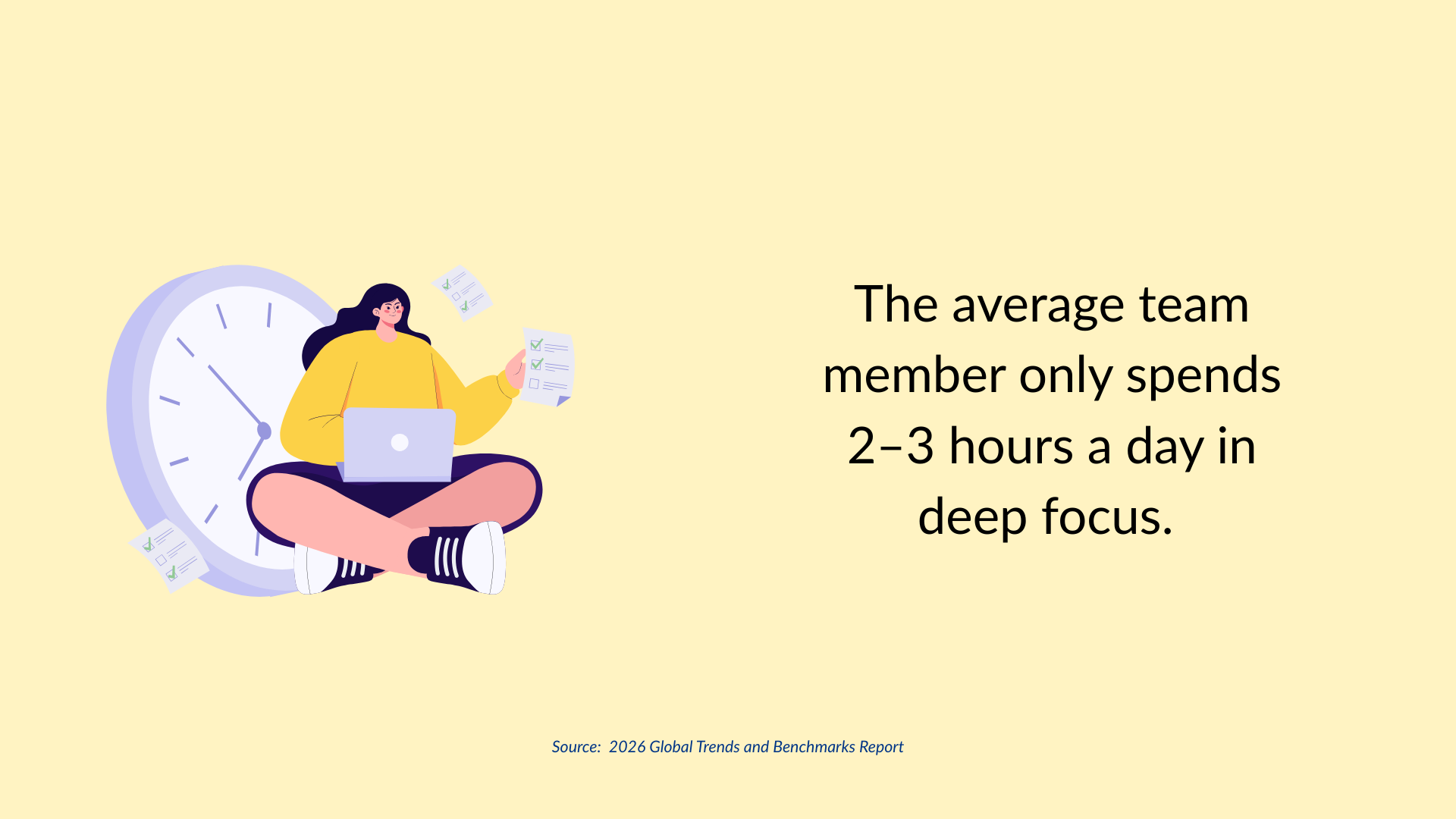
According to Hubstaff’s 2026 Global Work Index, based on data from over 140,000 workers across 17,000 organizations, the average team member only spends 2–3 hours a day in deep focus.
In this post, we’ll cover what AI time tracking is and how to use AI-powered time tracking to understand team focus time and productivity.
Stay in the loop
Subscribe to our blog for the latest remote work insights and productivity tips.
What is AI time tracking, and why is it different in 2026
Legacy time tracking platforms were built to answer a simple question: how long did a task take?
These tools measured clock-ins, hours logged, and projects assigned, often relying on manual entry and flat timesheets. While that helped quantify hours, it didn’t reflect how teams used them.
In 2026, AI-powered time tracking prioritizes productivity patterns over hours worked. It’s less about when or how much someone worked, it’s about how they worked.
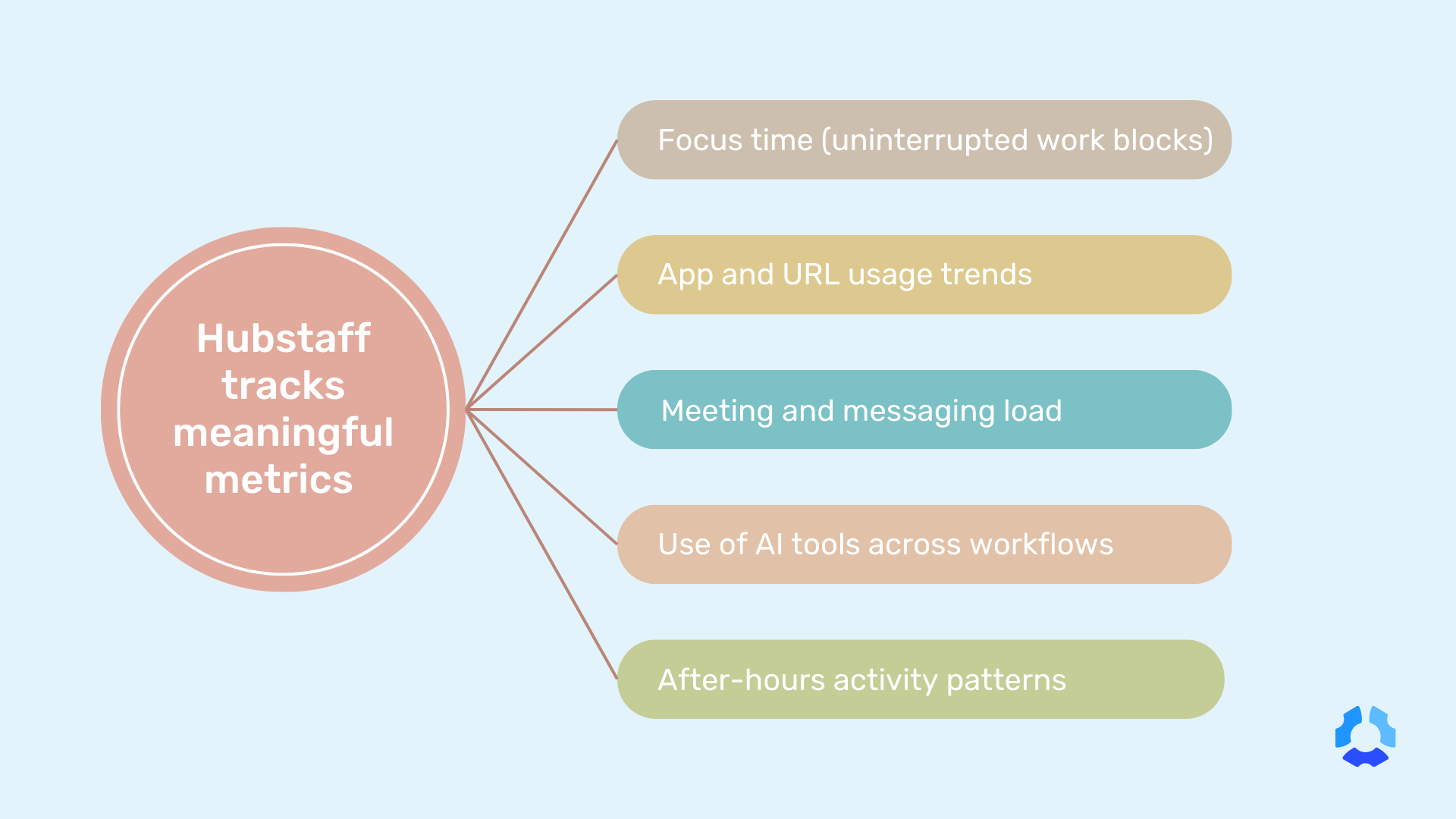
Powerful time tracking software platforms like Hubstaff empower this shift to surface meaningful productivity and activity tracking metrics, such as:
- Focus time (uninterrupted work blocks)
- App and URL usage trends
- Meeting and messaging load
- Use of AI tools across workflows
- After-hours activity patterns
These metrics really help see how distractions, overload, and time fragmentation shape output. Where legacy tools captured time, AI time tracking reveals operating rhythm, helping teams make better decisions about priorities, bandwidth, and workflow design.
Why focus time has become the new productivity KPI
Focus time is the uninterrupted time an individual spends in deep, meaningful work that drives real progress. It excludes meetings, notifications, and the mental tax of jumping between tasks.
In a world where attention span is scarce, focus time is the most valuable metric a team can measure. AI time tracking makes focus time visible and, more importantly, actionable. It helps teams detect invisible friction points, such as:
- Task fragmentation. This occurs when there’s an excess of small, disconnected tasks. Look to productivity methods like task batching to collect similar items and maintain prolonged focus.
- Meeting spread. When meeting time is spread across one’s calendar, it’s hard to fit in focused blocks of time for independent work. While it’s not always doable, try to keep meetings close in proximity for larger chunks of focus.
- Context switching. Jumping between apps, channels, and tools can create the illusion of a productive work day, but it’s far from it. This excessive context switching is actually less productive.
- Idle or unproductive time. This is probably the most obvious of challenges, but one of the hardest to prevent. To avoid extended periods of unproductive or idle time, look to productivity methods with built-in breaks like the Pomodoro Technique.
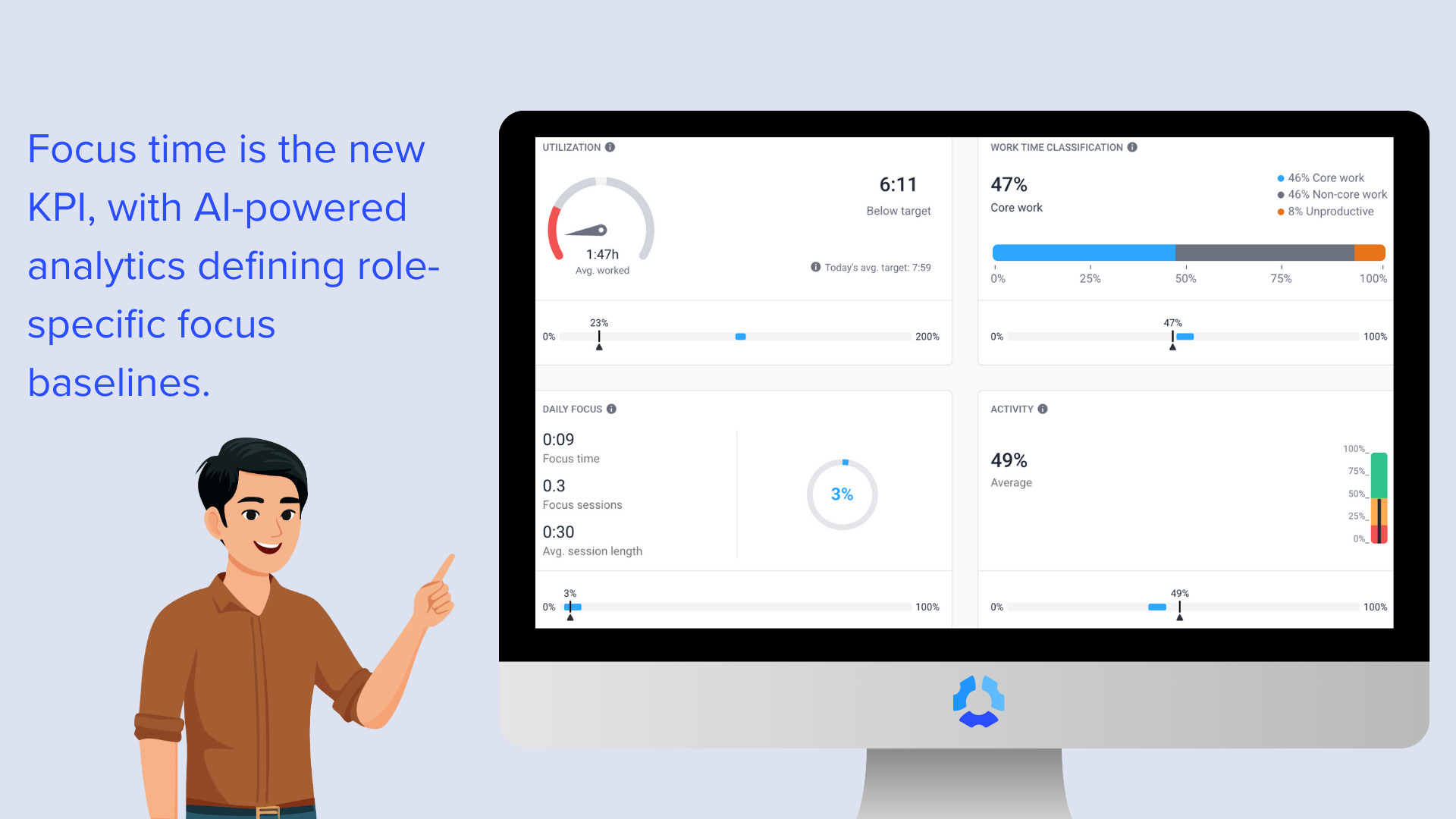
In 2026, leading organizations are treating focus time as a core KPI, alongside throughput and quality. AI-powered workforce analytics also highlight role-specific focus baselines. In other words, a designer’s 40% focus time might be healthy, while a project manager’s 20% could be just right.
It’s not about maximizing every minute. Instead, it’s about designing smarter weeks where deep work is protected, distractions are managed, and teams operate with clarity.
AI time tracking reveals how work actually happens across time zones
The primary challenge for global teams in 2026 is no longer about proving whether people are working. These days, it’s more about understanding how they utilize those hours to work across time zones, roles, and rhythms.
AI tracking of employee productivity ensures leaders have a data-backed view of actual operating patterns, rather than relying on outdated assumptions or one-size-fits-all schedules.
Hubstaff’s 2026 Global Work Index shows that work rhythms vary widely:
- Creators and analysts need long blocks of quiet focus.
- Managers are coordinating across roles and time zones.
- Customer-facing teams rely on short bursts of availability.
Rather than rhythms associated with a traditional 9–5, global teams are experiencing triple-peak workdays, where team members have:
- A deep focus window in the morning
- Another stretch after lunch
- A third, late-evening push after personal commitments
The data shows this triple-peak pattern appears in 1 in 5 weekdays. While it offers flexibility, it also doubles the workday and risks burnout if used by default.
That’s why AI time tracking is essential. It doesn’t just capture hours worked, it detects:
- Overlap windows across hubs
- After-hours work patterns
- Who’s collaborating live
- Who’s falling into always-on fatigue
- How distributed rhythms impact focus and well-being
When teams spread across time zones, assumptions aren’t enough. You need real data on work rhythm, capacity, and focus to design a system that scales sustainably, without burning people out or blurring boundaries.
From AI adoption to AI workflow: What time data shows
AI is everywhere in workplace conversations, but adoption doesn’t always translate into impact. Hubstaff data shows 85% of professionals report using AI at work, yet AI accounts for just 4% of total work time, highlighting a major gap between adoption and real workflow integration.
That gap reveals a few clear patterns:
- Most teams are dabbling with AI but not yet integrating it into their day-to-day workflows.
- Hubstaff’s AI Productivity Shift panel found that teams aren’t failing to adopt AI; they’re struggling to trust it.
- For many roles, AI is still just a helper, a quick draft, a brainstorm prompt, or a faster reply. It’s not a true shift in how work gets done.
Despite these findings, there are exceptions. For instance, hybrid teams and engineers are emerging as power users:
- Engineers lead other professions in AI adoption, with 87% adoption.
- Hybrid teams show the highest AI integration overall, with usage rising from 5% to 11% of the workday.
- Engineering teams spend 8% of their tracked time in AI tools, up nearly double from the previous year.
This is where AI time tracking becomes essential; it doesn’t just check if someone is using an AI tool. It helps teams understand:
- How often is AI actually used in workflows
- Which roles and teams are building repeatable, embedded patterns
- Where AI is reducing task time, boosting focus, and lowering distraction
In other words, AI time tracking reveals where AI has become a workflow optimizer and an assistant.
Capacity planning and burnout signals you can’t see without AI
If your team needs 50+ hour workweeks to keep up, that’s not dedication, it’s a flawed system.
Long hours are often a lagging indicator and, by the time burnout shows up in attrition, missed deadlines, or disengagement, the damage is already done. The real risk lies earlier, hidden in how work is distributed and sustained over time.
For agencies, this lack of visibility directly impacts capacity planning and margins. AI time tracking surfaces the signals leaders usually miss and identifies paths to increase profits.
AI time tracking surfaces the signals leaders usually miss.
By connecting hours worked, utilization, and focus time, teams can spot:
- Chronic overutilization before it becomes burnout
- Declining focus time even as total hours increase
- Teams compensating for broken workflows with longer days
Time data shows the tradeoffs clearly: as hours climb, focus drops, context switching rises, and productivity erodes. What looks like “high output” on paper is often an unsustainable effort underneath.
AI-powered insights help leaders rebalance capacity, redesign workflows, and protect focus, before burnout becomes the cost of doing business.
What the 2026 Global Trends and Benchmark Report Adds
The real value of time data isn’t just visibility, it’s context.
Hubstaff’s 2026 Global Trends and Benchmark Report analyzes data from 140,000+ people across 17,000 teams, combined with external research, to show how modern work actually functions across distributed environments.
The report unlocks benchmarks leaders can act on, including:
- Roles, industries, and workstyle comparisons to spot inconsistencies.
- Focus time as a comparative KPI, not just hours worked.
- AI usage depth by role and region, revealing where AI is embedded vs. experimental.
- Global time-zone overlap patterns to design healthier collaboration windows.
- Leadership grounded in real data, not assumptions.
Instead of guessing whether your team is overworked, underutilized, or falling behind peers, you can see exactly where you stand and what to adjust.
Access the 2026 Global Trends and Benchmark Report to explore the data shaping how high-performing teams work today.
Try Hubstaff’s AI time tracking
Hubstaff is an AI time tracking software platform with built-in productivity monitoring that goes beyond tracking work hours to provide AI-driven visibility into how work actually gets done.
Hubstaff Insights turns raw hours into actionable signals leaders and teams can use to improve performance without micromanagement. Key capabilities include:
- Focus time tracking to understand deep work vs. fragmented effort
- AI tool usage tracking to measure real workflow integration, not just adoption
- App and URL activity patterns to identify distractions and workflow friction
- Capacity, utilization, and hours monitoring to surface burnout risk early
- Role- and team-level insights teams can review themselves, not just managers
Hubstaff is built for modern, distributed teams who want accountability without surveillance, and insight without guesswork. Productivity data is live and visible, which empowers both team leads and individual contributors to course-correct faster, work more sustainably, and use AI where it actually delivers value.
Leading teams are redesigning work with AI time tracking
In 2026, high-performing global teams aren’t relying on longer hours or constant availability; they’re redesigning work with data. AI time tracking makes this possible by revealing how focus time, AI usage, and workload distribution actually impact productivity, engagement, and profitability.
By protecting deep focus, identifying where AI truly improves workflows, spotting burnout signals early, and designing collaboration around real-time time-zone overlap, teams can build systems that scale sustainably. Download Hubstaff’s 2026 Global Trends and Benchmark Report to see how leading teams are turning time data into smarter work design.
Most popular
7 Tools That Help Monitor AI Usage at Work in 2026
AI is everywhere. Adoption continues to grow, but from monitoring AI usage, we’ve learned that daily use is still a mixed bag, a...
Hidden AI Usage in the Workplace: What Your Tools Don’t Tell You
How much has AI changed your team’s work? On the surface, work might not look that different. The meetings are still there, docu...
How Many Meetings Are Too Many? 2026 Benchmarks by Role
How many meetings are too many? In 2026, the honest and boring answer is: it depends on your role. Our 2026 Global Trends and Benc...
When Evening Work Becomes a Red Flag: How to Fix Triple-Peak Overload with Smarter Core Hours (2026 Data)
Most people don’t remember the first time they worked in the evening, and even fewer people know when the last evening work sess...