AI is already reshaping how work gets done: what people do, how they do it, and how quickly they can deliver. But there's a gap between enthusiasm and execution.
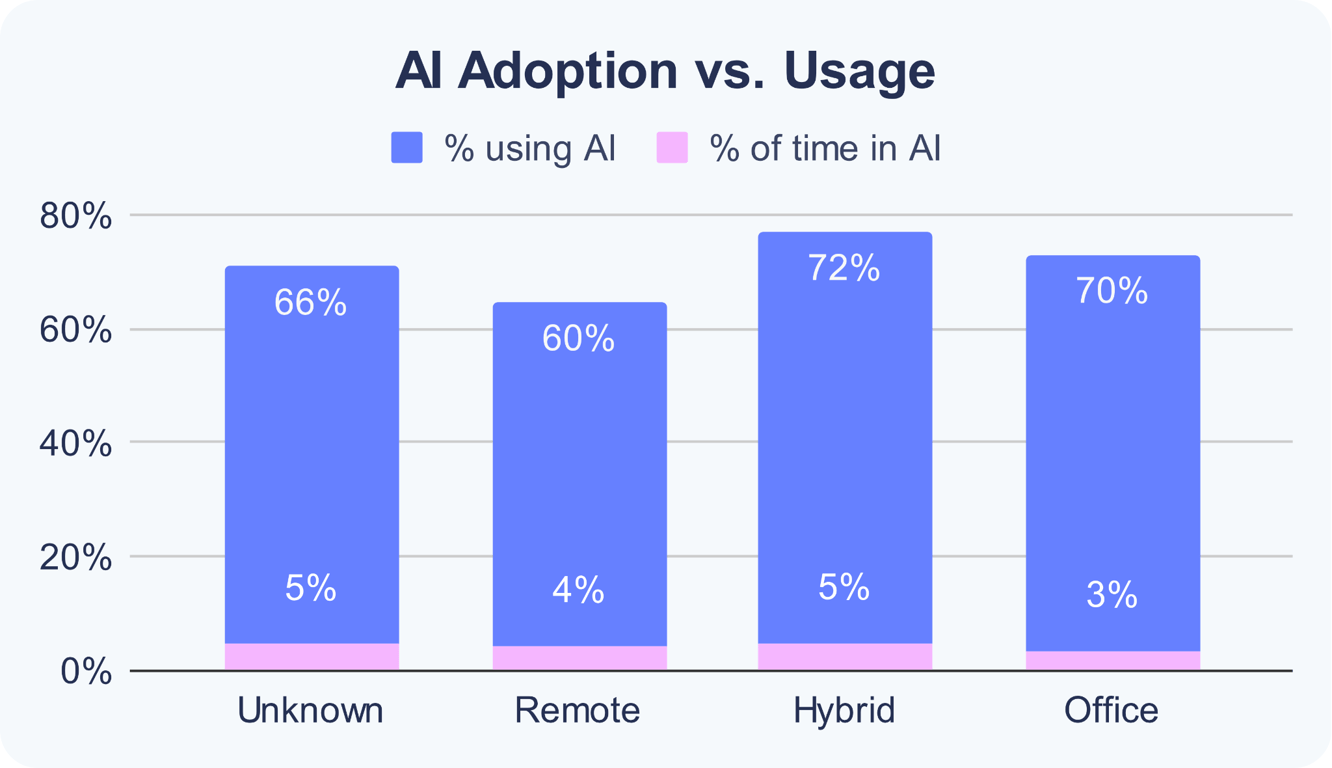
- 67% of Hubstaff users use AI for work, but only 4% of their total work time is spent using AI tools
- While that figure may seem low at first glance, it compares to usage of some of the most essential workplace apps, like Slack (3.53%) and Gmail (3.91%). Google Docs tops the list at 6.44%, but even that only modestly edges out AI's footprint.
- 85% of surveyed professionals say they use AI, but for many, that means the occasional ChatGPT prompt.
The chart below shows the split: adoption is high while usage stays shallow.
The average team spends less than 5% of its time on AI tools, and early adopters have moved past experimenting to rebuilding work with AI as the engine.
High adoption, low usage
Most teams aren't deciding whether to use AI anymore; that decision's been made. The survey data lays it out clearly:
- A majority, 60%, use AI regularly
- Another 20% are still experimenting
- And 15% haven't started at all
The 15% who haven't started are already behind, because AI adoption has reached a tipping point.
Small teams move faster
Smaller companies are showing the highest AI adoption (67%) and the most time spent in AI tools (5%). Larger enterprises are further behind at 43% adoption and lower usage (4%).
Speed and agility set small teams apart. Without layers of red tape, they can test, adapt, and integrate AI quickly, and if it works, they run with it.
For these agile teams, AI works as a daily advantage rather than a future investment.
Mid-sized companies are following close behind, and while big players move cautiously, they have the scale and resources to move fast once they commit.
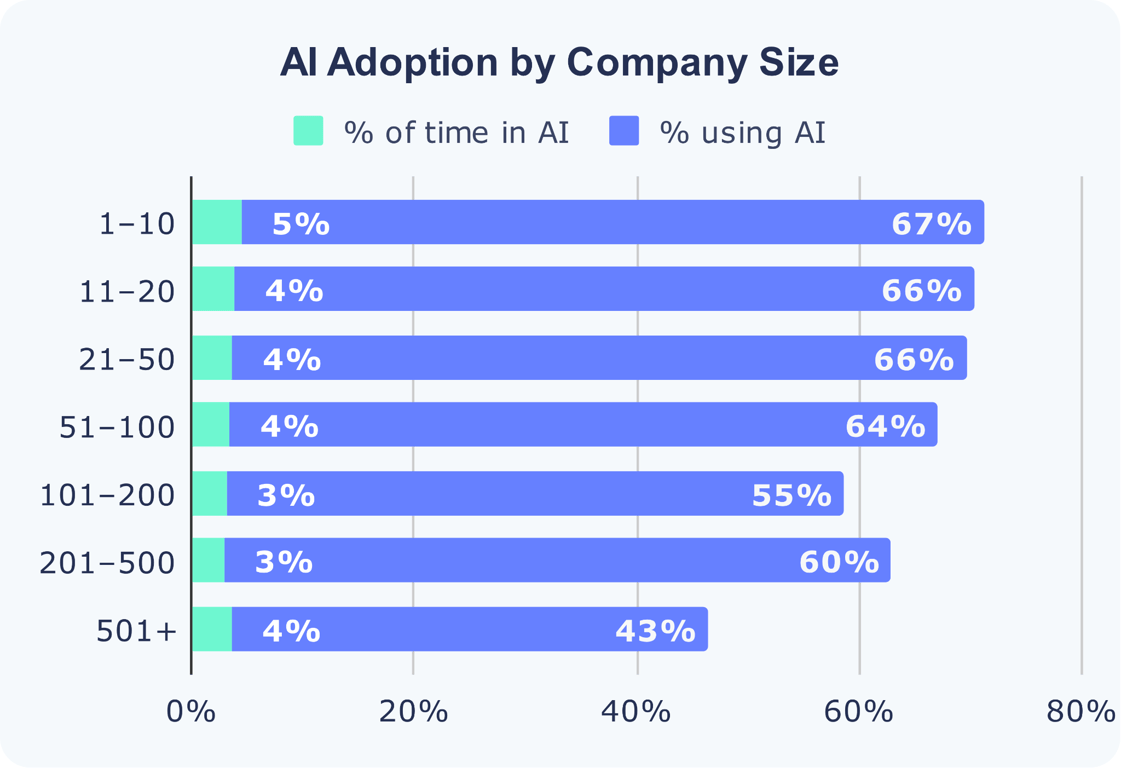
“The "innovator's dilemma" is about to accelerate. As Hubstaff's report shows, smaller companies aren't just adopting AI more than their larger competitors (67% vs 43%), but they're spending more time in the tools.
Smaller companies have always been more nimble: they've got clarity of purpose, and leaders who are deeply engaged in the work with their teams. Leaders in larger organizations need to take heed and get into the tools alongside their teams.
The potential for generative AI to augment smaller teams means their development accelerates even faster – creating a greater threat than ever to incumbents.” — Brian Elliot, CEO at Work Forward
Smarter, not just faster
The real opportunity is in unlocking better ways to work, not just replacing people or doing more with less.
“AI isn’t just helping us move faster—it’s helping us move smarter. We use SurferSEO and ChatGPT to build high-performing content faster, while sentiment analysis tools help us decode competitor strategy in real time.
AI now informs how we position products, prioritize leads, and craft messaging across the funnel. The real shift is what’s coming next: autonomous agents that identify our ideal customers, surface clients at risk for churn, and trigger precision outreach—before a human even gets involved.
If your marketing org isn’t rethinking its stack around AI, you’re already behind.” — Alex Schutte, SVP, Marketing at Hubstaff
Cutting out the busywork creates space for deep work, faster feedback loops, and high-impact thinking.
Used as a quick shortcut, AI tends to deliver small wins. Built into your strategy, it produces smarter systems, faster teams, and more resilient businesses.
Industries racing ahead with AI
Cleaning services, development, and general contracting are using AI to streamline operations.
Blockchain, crypto, and online education teams are scaling faster by automating communications, personalizing content, and cutting down admin time.
These industries rank among the most resourceful, even when they aren't the most technical.
Healthcare and logistics are moving more cautiously, though not for lack of potential. Compliance hurdles, legacy systems, and risk-averse cultures are slowing them down.
Those constraints are where the opening sits. In every industry, the first teams to adopt AI effectively gain a serious edge and push expectations higher for everyone else.
AI power users
Here's the pass on this section:
Some roles have gone beyond adopting AI to building it into their daily workflows. These are the early movers:
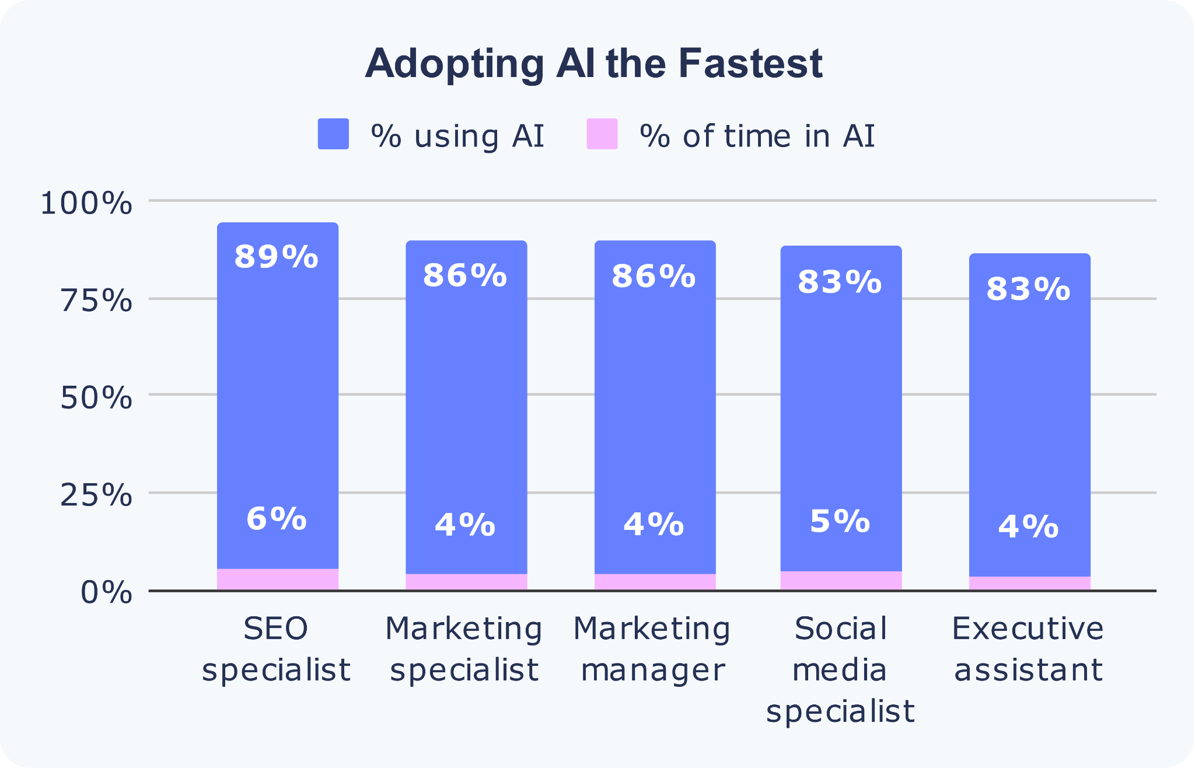
SEO specialists are out front, with 89% adoption and the highest AI time (9%). Marketing managers follow closely, and executive assistants aren't far behind.
Writers now spend 9% of their time in AI apps, which makes them one of the most engaged AI user groups across all roles.
These roles share a few traits: high pressure, constant context-switching, and the need to deliver fast. AI helps them streamline repetitive tasks, generate ideas, and scale output without compromising quality.
They've moved from using AI to optimizing with it. Finance, sales, and data ops still lag in both adoption and usage, even though they're among the most automation-ready functions on the org chart.
AI works best as a fast, focused co-pilot that jumps in to handle repetitive tasks, assist with analysis, or speed up content creation. The goal is to use AI strategically where it adds the most value, rather than clocking more time in AI apps.
AI momentum worldwide
AI adoption is gaining ground across the globe, and the fastest movers aren't only the most resourced regions. Countries with strong freelancing cultures, tech services, or lean operations are adopting AI quickest. In these environments, AI has become a necessity rather than a novelty.
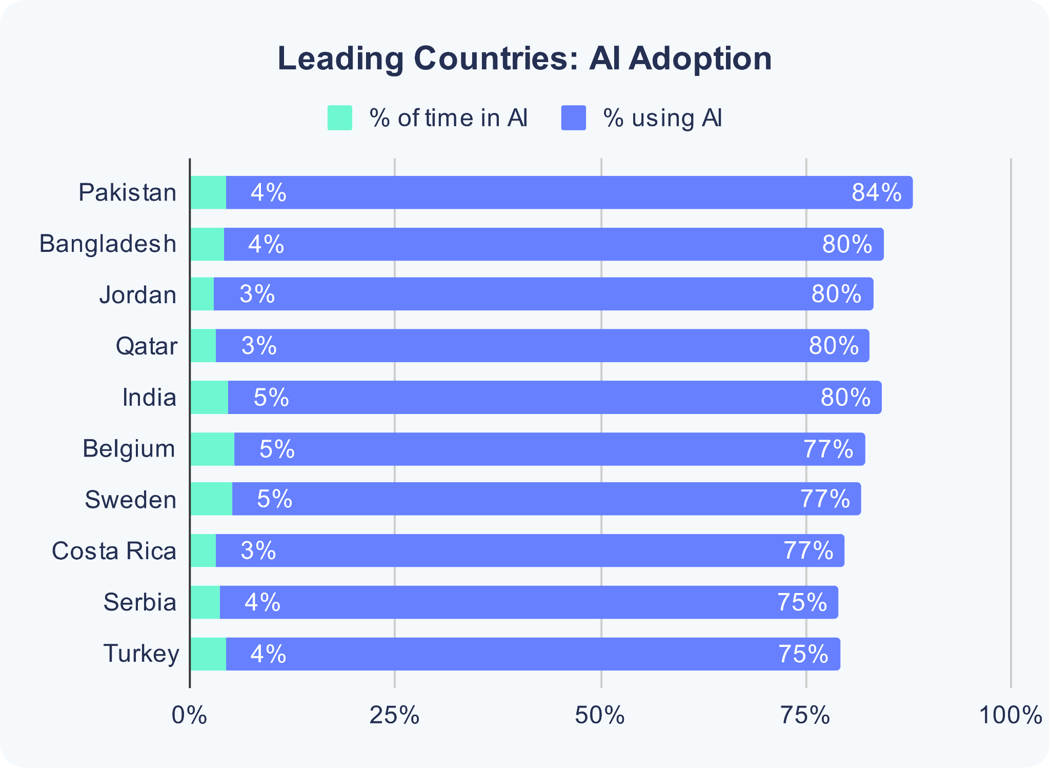
- Pakistan (84%), Bangladesh (80%), and India (80%) lead globally in adoption, with teams regularly spending 5% of their work time in AI tools.
- Jordan and Qatar are close behind, driven by growing tech investment and innovation in the MENA region.
- Digitally mature economies like Belgium, Sweden, and Malaysia are also adopting AI, which shows momentum reaching well beyond emerging markets.
- Colombia (49%) and Chile (65%) show more cautious adoption in Latin America, signaling ongoing digital transformation.
- In the United States, AI usage is 56%, with just 4% of work time spent in AI tools, less than India and even behind Italy and Switzerland in terms of depth.
- Dominican Republic (15%) and Cambodia (16%) show the lowest adoption rates, with under 4% of work time in AI, which highlights barriers around access, training, or infrastructure.
Some regions are still early in adoption, which leaves plenty of room to grow.
What to do next. Read how to use AI at work for productivity for step-by-step instructions for setting up your first 1-2 AI augmentations.
AI stack is growing
It started with ChatGPT and is becoming an ecosystem that grows more specialized, embedded, and strategic by the day.
Among survey respondents, 90% say they use ChatGPT, but real-world usage looks more varied. ChatGPT leads in awareness, while QuillBot and Grammarly show stronger day-to-day engagement, embedded directly into people's workflows.
Other tools are spreading fast: Notion AI, Airtable AI, and Claude get used for note-taking, organization, and research. Copilot has 58% awareness but just 2.57% usage, a gap between recognition and real utility.
Here is some inspiration:
- Inbox relief: Switch on Copilot (Outlook) or Gemini (Gmail) for 1-click replies to low-effort emails. Saves 5-10 mins a day, plus the inbox stress.
- Meeting overload: tl;dv auto-summarizes Zoom calls with action items, and Scribe builds how-to guides from your screen recordings.
- SEO and content: Draft briefs in Surfer, then repurpose blog posts with ChatGPT into tweets, summaries, or landing page intros.
- Admin pain: Motion auto-schedules meetings, drafts status updates, and reorders your to-dos by priority.
- Competitive intel: Point Browse AI at competitor sites to track and summarize changes, then let Claude or Perplexity turn that into positioning insights.
- Creative edge: Descript lets you edit video by editing text, and ElevenLabs clones your voice for content clips or personalized support audio.
AI governance is catching up
As AI moves from experimentation to everyday use, companies are building smarter, more thoughtful frameworks to guide it. Adoption is becoming intentional rather than casual.
These frameworks aim to create clarity and confidence, without slowing innovation. With the right structure, teams know where AI adds value, what's encouraged, and where the boundaries sit. The more confidently teams use AI, the more value they get from it.
Pro tip. Create a clear AI policy. Define how AI can be used, which tools are approved, and what's off-limits. Protect your IP by disabling "Improve model" in AI tools to keep your company data from training public models.
- 65% of AI-using companies now have formal adoption policies
- Many teams are rolling out training, building internal AI guidelines, and creating space for safe experimentation