The Best Coaching Conversations Start With Productivity Data

 8 min read
- Productivity metrics like focus time and work allocation are most valuable as early warning signals — a shift from someone's baseline should prompt a coaching question, not a performance verdict.
- Coaching the metric directly backfires; if you tell someone their focus time is low, you'll get a better number with no real change — use data as a doorway into the conversation, not the conclusion.
- When the same pattern appears across your whole team, stop coaching individuals and start examining structure — meeting culture, unclear priorities, or resource gaps are likely the real issue to solve.

Most coaching conversations happen too late. A deadline is missed, or a client flags a problem, and then a manager schedules a sit-down to figure out what’s up. I’ve been on both sides, and almost every time, what’s finally being discussed has been building up for weeks.
When I was a college gymnast, the coaches who made the greatest impact on me were the ones who never waited for scores to tell me something wasn’t working. They watched how I moved in the gym, and they would pull me aside before a bad habit in my training ever cost me in competition. That’s what coaching is all about. It is not grading performance after the fact. It’s catching problems before they arise and starting the conversation while there is still room to change the outcome.
Productivity coaching in the workplace is the same. Managers don’t ignore problems on purpose. Most just don’t have a reliable way to spot issues before poor results make it obvious. Productivity data can help, not as a scoreboard, but as a layer that tells managers where to look. But managers have to do the hard part to shift mindsets and team outcomes.
Stay in the loop
Subscribe to our blog for the latest remote work insights and productivity tips.
Most performance coaching starts too late
Email campaigns are underperforming, or a sales team member consistently isn’t connecting with the right targets. These are lagging indicators, and by the time they come to light, the coaching conversation should already have happened.
This gets harder in distributed organizations, and I say that as someone who leads a marketing team spread all over the world. If everyone worked from the same building, you might be able to pick up on things like a colleague’s mood or irregular schedule. That proximity doesn’t exist in my reality, so the input has to come from somewhere else. Leaders need a signal that it’s time to have a talk.
Productivity data can serve up coaching moments earlier
Productivity data is great for pattern recognition, showing you when something has changed from a team member’s baseline, whether that is focus time, the split between core and non-core work, working hours, or how time is allocated across projects.
A single data point is rarely enough, but identifying shifts is important. For example, if I saw that a marketing coordinator who normally spends most of their week on campaign execution flips and most of their time goes to meetings and internal communication, that’s a moment I should pause and ask a question. Has something changed about how this person’s work is structured, and is that intentional? This is the same shift I mean when I talk about using data to improve team productivity rather than just to police it.
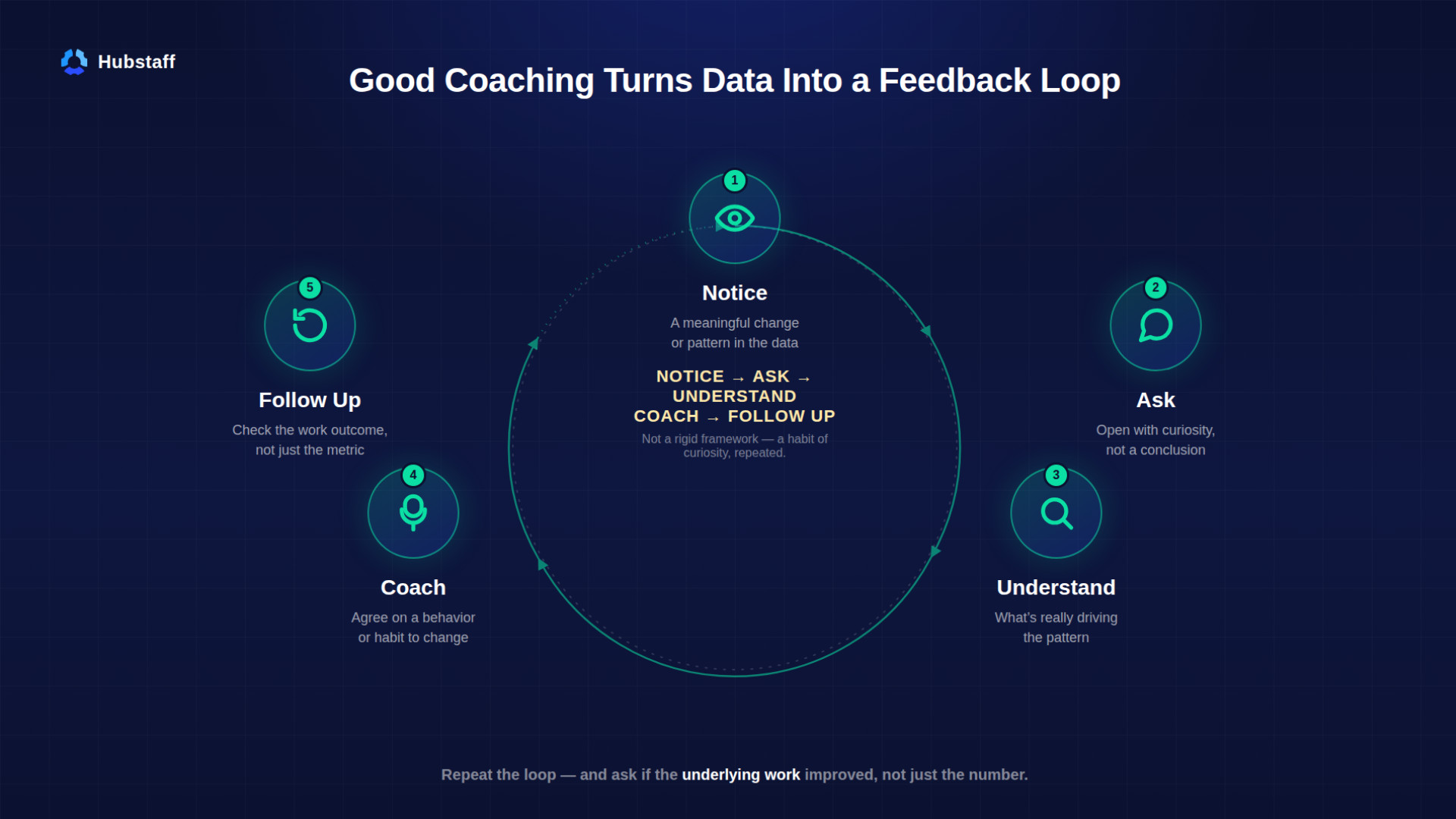
Now imagine the same pattern is showing up across the entire team. The question changes from “What is happening with the marketing coordinator?” to “What is happening with the work itself?”
The data tells you where to look
This is the important part: productivity data cannot tell you why something has changed (and it should never be asked to). A data shift can be a flashing red light, but it’s still up to a manager to figure out what it means about someone’s work.
A decline in focus time could mean meeting overload, a new set of responsibilities nobody formally assigned, or a project with unexpected challenges. A drop in core work could be admin time creeping up, or unclear direction about what matters this month. Rising hours might reflect a heavier workload, an inefficient process, or the early signs of burnout.
Let’s think about this in a different way. Say a marketing manager’s execution hours drop sharply over a couple of weeks. You might be thinking it’s time to coach them on urgency. But before that conversation, it is worth checking whether a new approval process or stakeholder review got introduced upstream, because if it did, the drop is not their problem. It is a process problem with their name attached to it (and a great reminder that measuring productivity fairly across roles should always be a concern). This is exactly why I treat team performance metrics as a starting question, never a final answer.
Don’t coach the metric: coach the behavior
The fastest way to devalue productivity data is to hand a team member a number or score and tell them to improve it. If you say “your focus time is too low” enough times, you will get exactly that: a better-looking metric with no real change underneath it, because you told people what to optimize and they listened.
The better move is to treat every metric as a doorway into a question. Instead of “your focus time is too low,” ask what is making uninterrupted work difficult right now. Instead of “you aren’t spending enough time on core work,” explore digging into idle time vs. unproductive time to figure out what’s quietly taken over the calendar. Instead of “this project took too many hours,” dig into scope creep, client challenges, approval cycles, or a bad estimate going in.
I have seen both sides of this with my own teams. Campaigns that consistently blow past their estimated hours rarely need people to work faster; they need scope creep or slow approval processes fixed. A marketing team with high activity and long hours whose campaigns still miss targets is the clearest proof I know that activity is not performance, and coaching to that number would mean coaching the wrong thing entirely. Coaching should always be aimed at something actionable: prioritization, planning, communication, delegation, workflow. Never a dashboard number.
Coaching is bigger than individual team members
Coaching team members can certainly improve individual performance, and it can also reveal bigger challenges for your business. These conversations can uncover organization-wide trouble with workload, process friction, meeting overhead crowding out focused time, or a management clarity problem where priorities were never made clear in the first place.
But even in the face of bigger issues, team members still need to be accountable. Managers just need to stay focused on solving performance problems within the broader context of what’s going on. If a content strategist’s output drops while the team is short-staffed, that person might be quietly absorbing extra responsibilities nobody formally handed off. That coaching conversation should be about workload and resourcing, not that person’s individual performance.
Good coaching turns data into a feedback loop
The managers who get real value out of productivity data treat it as an ongoing loop: notice a meaningful pattern, ask with curiosity rather than jumping to conclusions, understand what is driving it, coach toward a specific behavior that can realistically change, then follow up.
When I was in competitive gymnastics my scores identified patterns. My coaches didn’t just tell me to get better scores; we worked together to identify areas of improvement and focused on meaningful change.
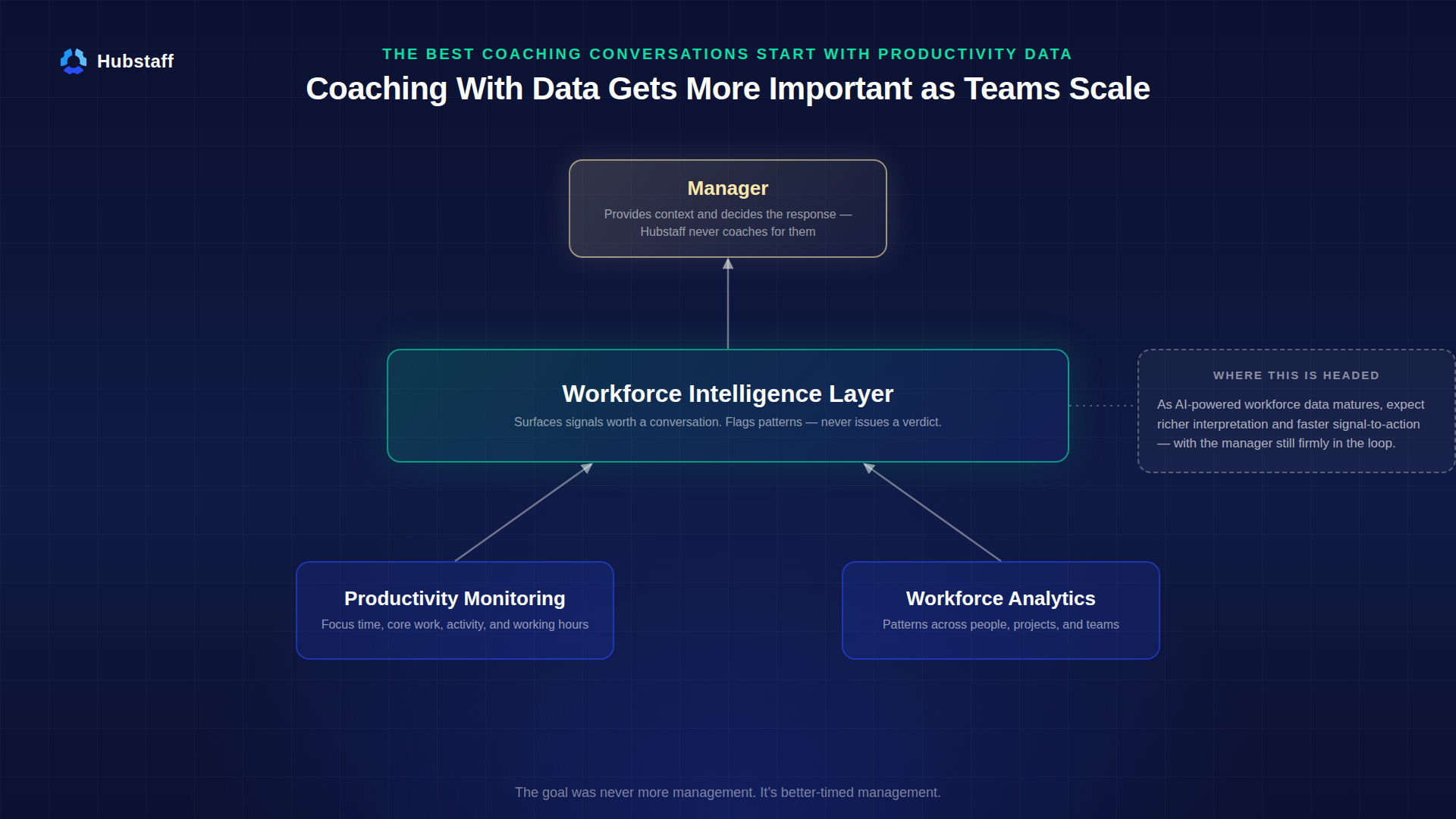
Don’t forget that last step. Yes, look if the metric moved, but also ask whether the underlying work outcome improved. A rise in someone’s focus time percentage means nothing if project delivery has not gotten any better. Picture a strong marketing coordinator consistently hitting every target while their hours creep up for a couple of months. Nothing here looks broken, but the follow-up conversation still matters, and it is about workload and sustainability, not performance.
Coaching with data gets more important as teams scale
Coaching matters for every team, but becomes more important as teams grow. A founder with six people usually knows what is happening with each of them through daily proximity. That does not survive scale. Once you are managing distributed teams over 50+ across time zones, multiple client accounts, and hundreds of employees spread across dozens of managers, there is no version of proximity that covers all of it.
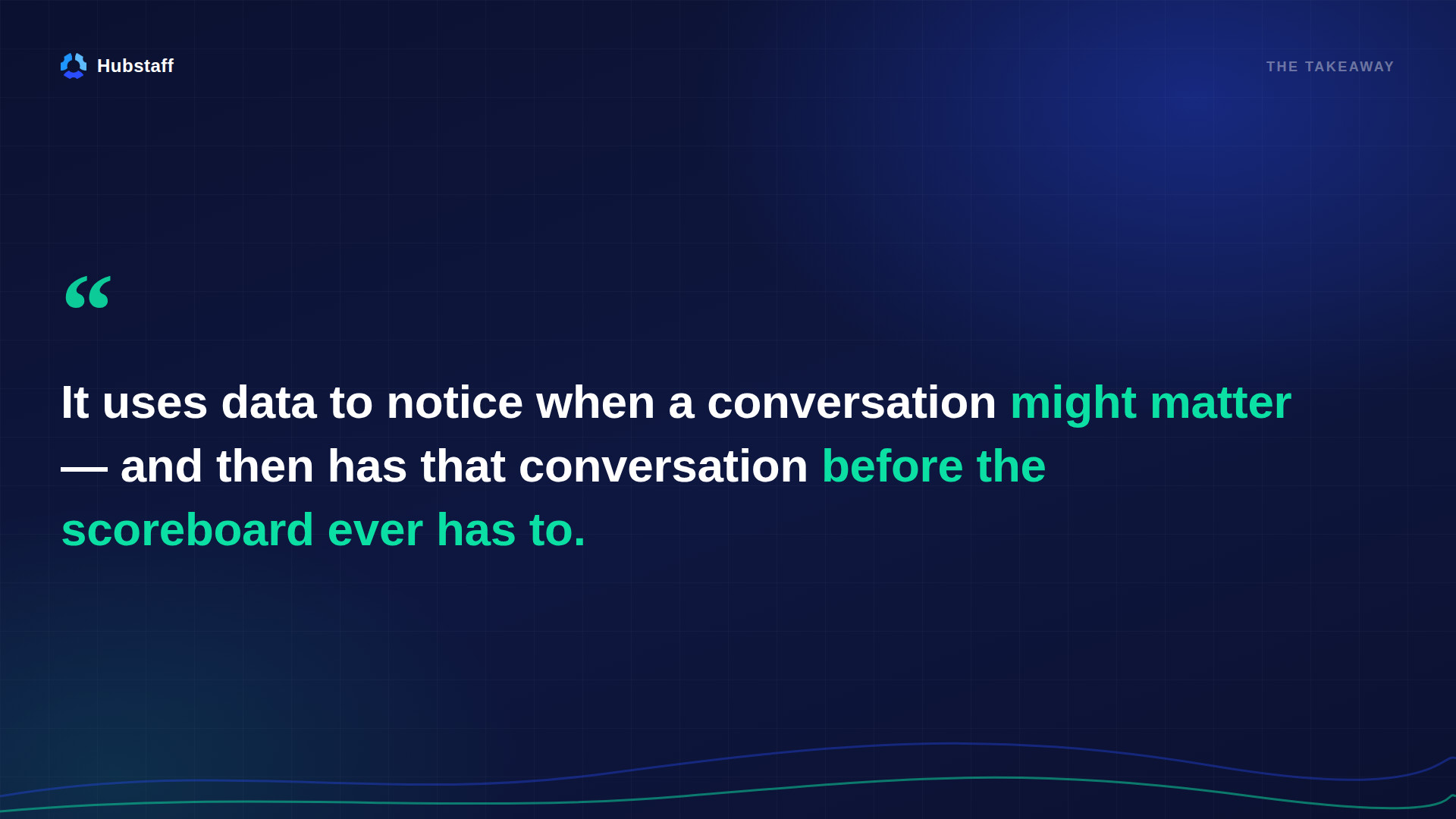
At that scale, organizations need a consistent foundation for managers to know where individuals or teams might need support, which is a workforce intelligence problem rather than an individual metrics problem. The goal was never more management. It is better-timed management, delivered to the people close enough to the work to act on it.
This is the gap Hubstaff’s workforce intelligence layer is built to close, sitting on top of time tracking, workforce analytics and productivity monitoring to surface signals that make earlier coaching possible. The platform flags, but doesn’t make judgment. The manager still provides context and decides what the right response is, and as AI-powered workforce data matures, I expect that gap between signal and action to keep shrinking while the manager stays firmly in the loop.
The same principle works at the team level
If one person’s work pattern changes, your coaching conversation should be geared toward their individual context. But if an entire team shows the same shift all at once, the coaching opportunity is bigger than one person. This is about the manager, the workflow, the meeting culture, or how resources are allocated.
If one person on the team has a drop in focus time, that’s a conversation about individual workload. Conversely, if the entire team’s focus time drops the same week a new recurring meeting gets added to every calendar, that is not five performance conversations waiting to happen. It is one structural conversation, and it usually points back at whoever added the meeting.
Data tells a manager where to look. The conversation tells them what it means. And the coaching target should always be the behavior behind the metric, never the metric itself.
The management approach I believe in does not wait until a bad outcome makes a problem impossible to ignore, and it does not judge people from a dashboard. It uses data to notice when a conversation might matter, and then it has that conversation before the scoreboard ever has to.
FAQs
What is productivity coaching?
Productivity coaching is a management approach that uses objective signals, like focus time, working hours, or project allocation, to identify when a coaching conversation might be worth having, rather than waiting for a missed deadline or a formal review to surface the issue.
How is data-driven coaching different from performance monitoring?
Performance monitoring tends to treat a metric as the verdict. Data-driven coaching treats a metric as a starting point for a conversation. The data flags a change; the manager and employee still have to talk through what actually caused it before deciding whether anything needs to change.
Should managers coach team members to improve a specific metric, like focus time?
No. Coaching directly to a metric teaches people to optimize the number instead of the underlying work. A better approach is to use the metric as a prompt for a conversation about what is actually making the work harder, whether that is meeting load, unclear priorities, or process friction.
Does low activity always mean someone is underperforming?
No. A change in someone’s activity pattern is a signal to investigate, not a verdict on their performance. Low activity can reflect anything from a shift in responsibilities to a process bottleneck outside the team member’s control, so context always has to come before a conclusion.
How does productivity coaching work for distributed and hybrid teams?
Distributed teams lose a lot of the informal, in-person cues managers used to rely on, so objective workforce data becomes a substitute for that lost visibility. It gives managers of remote and hybrid teams an earlier, more consistent way to notice when a conversation might be needed, without requiring constant check-ins.
See what’s changing in how your team works, before it shows up on the scoreboard
Hubstaff gives managers the objective workforce signals they need to start earlier and have more focused coaching conversations, without adding more check-ins or relying on constant in-person proximity to know what’s going on.
Most popular
The Top Time Management Statistics in 2026 for Workplace Productivity
We all have the same hours in the day. But when employees struggle to focus, those hours likely won’t be used effectively. Witho...
The Best Coaching Conversations Start With Productivity Data
Most coaching conversations happen too late. A deadline is missed, or a client flags a problem, and then a manager schedules a sit...
A Quick Guide to Work Order Management
From quick fixes to long-term stability, work orders are crucial to asset management and helping managers keep operations running...
How to Identify High Performers Using Work Patterns
Every business has top performers, and managers are told to find them all the time. But in most cases, they default to approaches...