Just because one person owns the outcome doesn’t mean collaboration disappears. It simply starts having a center of gravity.
2. Measurable success criteria (what “done” means)
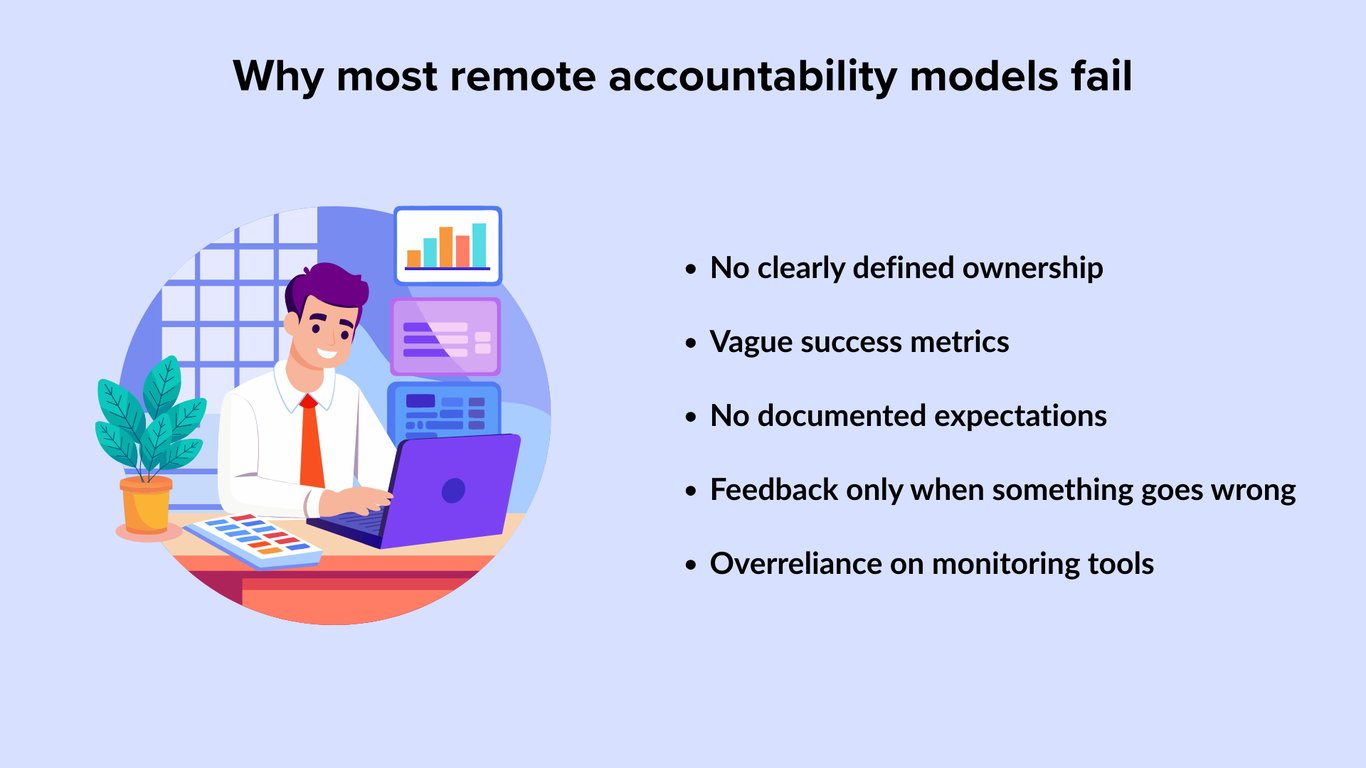
Most remote accountability issues come from a lack of definition.
Teams say a project is “almost done,” or “on track,” or “looking good.”
Those phrases sound reassuring, but they don’t anchor anything. They don’t tell you what success looks like in a way that two different people would interpret the same way.
Accountability requires measurable outcomes. Otherwise, evaluation becomes interpretive.
This is why KPIs and OKRs are so important.
A KPI ties performance to a number that moves. An OKR connects that number to a broader objective. When both are written down and visible, “progress” becomes something you can measure.
Deadlines matter for the same reason. A deliverable without a date floats, but the moment you attach a specific deadline, time becomes part of the definition of “done.”
Quality standards matter just as much. A report submitted on time but missing required analysis is not complete. A feature shipped without agreed functionality is not finished. If quality is assumed instead of described, accountability weakens at the edges.
Presence does not equal progress, and activity does not equal completion.
If “done” cannot be measured, ownership becomes opinion. And once that happens, trust starts to break down because everyone has their own idea of the finish line.
3. Transparent work visibility (shared source of truth)
For accountability to function, there needs to be a shared source of truth — a place where tasks, timelines, workload, and progress are documented in a way the team can see and reference without friction.
This is where visibility comes into the picture.
This also happens to be where many teams get uncomfortable.
Visibility supports accountability. It doesn’t define it.
If ownership is clear and success criteria are measurable, visibility is simply reinforcing. It allows managers to see workload distribution across the team. It helps prevent overloading high performers while others remain underutilized.
But visibility by itself doesn’t create responsibility; it only provides signals.
Many remote teams use productivity monitoring software to connect time data, task progress, and workload distribution into one operational view — not to watch people, but to avoid guessing about where work stands.
If you want a more detailed explanation of how remote productivity signals can be interpreted without micromanagement, we wrote an in-depth guide to remote worker productivity without micromanagement.
4. Feedback cadence (regular performance conversations)
Even with ownership defined and outcomes measured, accountability weakens if no one pauses to review what’s happening.
A real accountability system includes consistent review loops. Regular, predictable touchpoints where progress is examined while it’s still in motion.
Weekly reviews create rhythm and anchor goals to the calendar and force alignment before assumptions drift.
Retrospectives add perspective — they allow teams to step back and ask what worked, what didn’t, and what should change next cycle.
One-on-ones create space for individual ownership to be discussed without the noise of group dynamics.
The key is pattern-based feedback. Consistent conversations enable managers to identify trends instead of reacting to isolated incidents. A missed deadline becomes part of a broader signal, and consistent improvement becomes visible over time.
Without cadence, accountability becomes episodic. Cadence creates structure..
5. Corrective mechanisms (what happens when targets are missed)
Every accountability system gets pressure tested over time.
Maybe a deadline slips or a deliverable misses the mark. Sooner or later, the real workplace design shows itself.
If the only response is frustration or increased monitoring, the system isn’t fully-formed.
Corrective mechanisms exist so that misses trigger adjustment, not tension.
Sometimes the fix is workload rebalancing. A team member may own the outcome, but the capacity behind it was misjudged. Reassigning support or reducing parallel commitments can stabilize performance quickly.
Or sometimes, perhaps expectations weren’t defined tightly enough. In that case, the correction is specificity — rewriting the standard so the next attempt isn’t built on interpretation.
Coaching plays a role as well.
Skills gaps, prioritization issues, or decision bottlenecks don’t resolve themselves. Structured guidance can move performance forward without making it punitive.
There are also moments when the process itself is the problem. If multiple projects stall at the same stage, the design may need revision. Accountability involves workflows, too.
And in mature systems, there is an escalation structure. Clear thresholds and consequences with predefined responses tied to repeated misses.
The response to missed targets should feel procedural instead of emotional. This is when accountability turns from a monitoring exercise to an operational system.