Table of contents
- How Hubstaff structures work time data
- How Hubstaff turns structured work data into workforce analytics
- How teams use workforce analytics
- Built for operational visibility
- Take action with Hubstaff
In the time tracking space, it’s no longer enough to log work hours without context. If you’re wondering how Hubstaff turns time data into workforce analytics, look no further.
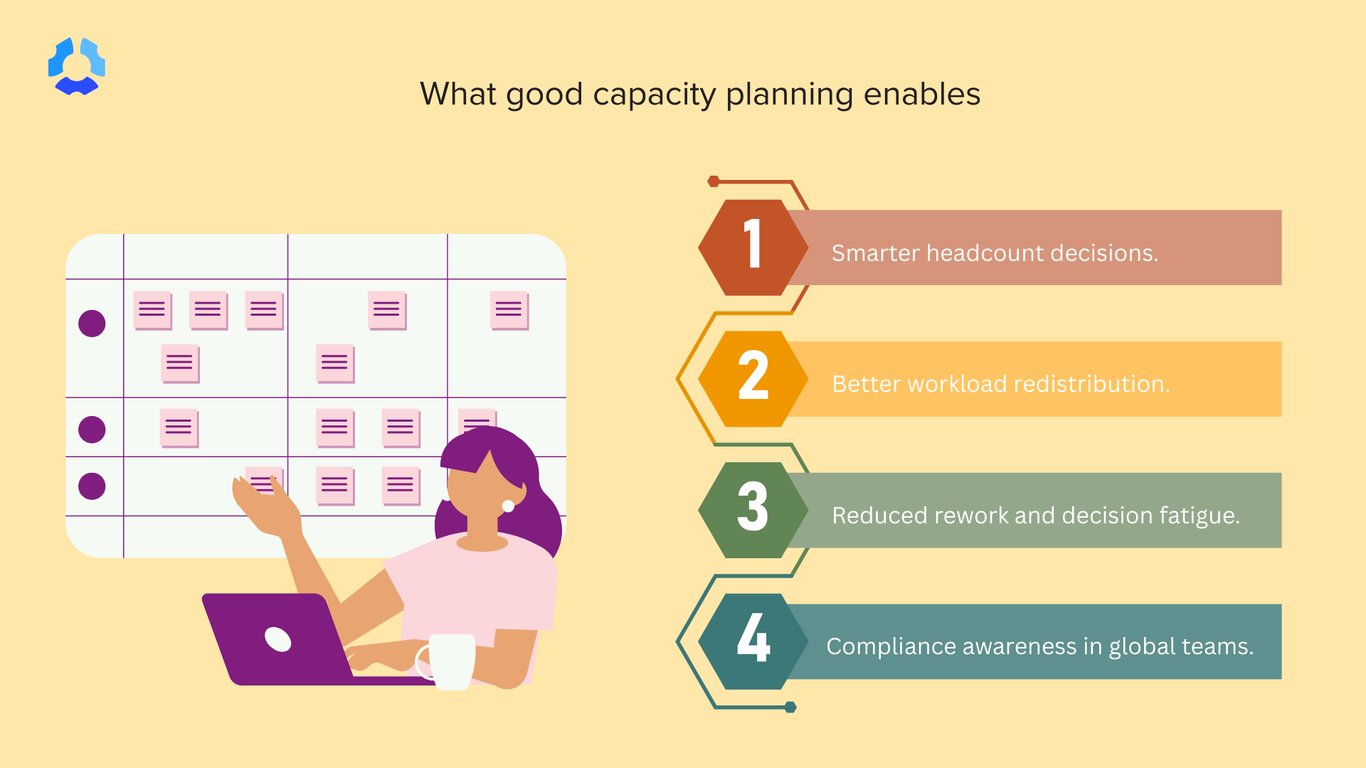
As businesses evolve and remote and hybrid work become increasingly prevalent, the need to look beyond basic time logs becomes increasingly important. With Hubstaff, our goal is to help users by:
That’s what workforce analytics is for, and that, in turn, is what Hubstaff is designed to do extremely well. But now that you understand what we’re capable of, let’s take a look at how Hubstaff achieves these outcomes.
Hubstaff is a versatile time tracking tool with built-in productivity, workforce analytics, payment, scheduling, and reporting capabilities. That’s quite a mouthful, so it’s best to break down data collection into a few different categories.
Every hour tracked in Hubstaff is attached to something, be it a project, a task, or a client. The data is organized from the moment it’s captured. Work sessions build towards a record of how time was spent, not just basic hours logs.
Together, these elements turn time entries from simple duration records into structured data points that Hubstaff’s powerful reporting and analytics features can work with.
While the timer runs, Hubstaff captures a layer of context around the work session. This is designed to give meaning to those hours. Activity metrics exist to provide that context, and they are most valuable when read alongside workload and project data.
These metrics are not designed to be read individually. To make the most of them, we recommend reading them alongside project context and workload data.
Not all teams work from a single device or location, which is why Hubstaff is designed to accommodate teams of all kinds.
Time tracked on desktop, the web app, and mobile all flow into the same system. Field teams also benefit from GPS tracking and location data for shift schedules and project attribution.
Hubstaff aggregates all data into a single record so managers have a single source of truth. Whether someone spends their morning on a job site and their afternoon at a desk, the data from every team member lands in one accessible place, ready for reporting.
Once work data has been recorded, classified, and aggregated, the next step is analysis.
You can use Hubstaff as granularly as you want to. It can zoom in on specific time periods in a given day, or provide a high-level overview of performance trends over the course of weeks, months, or years.
One of the things Hubstaff excels at is revealing how work time is distributed across meetings, projects, and focused work:
With Hubstaff, teams also see macro behavioral and operational signals, which are very useful when trying to understand how a team works without putting individuals under the magnifying glass.
If productivity patterns tell you how work happens, utilization and workload data tell you if workloads are evenly distributed. This way, you can uncover whether your business is carrying that workload sustainably.
These metrics, together, are what move workforce analytics from the reporting layer into operations.
No matter how valuable data is, if that data cannot be presented in a way that's easy to understand, that value will be difficult to prove.
Hubstaff was built to have a robust reporting and dashboard layer so that managers and operations leads can action the data in front of them.
You’ll know when a tool has good reporting capabilities when you can look at that data and act on it, whether that's adjusting a workload, updating a client, or making a staffing decision.
There is no one-size-fits-all value attached to workforce analytics. The benefit depends entirely on what a team is trying to solve. Different organizations come to Hubstaff with different operational problems, and the data the software reveals differs significantly depending on the work.
For agencies and client-service teams, time is the product, and workforce analytics is what keeps that product profitable at the core.
The operational questions are almost always the same:
Hubstaff provides answers to these questions.
For agencies, all of this means a real operational win — they can protect their margins, better understand their utilization, and save valuable time trying to manage both.
Engineering and technical teams have a different relationship with time than most. They tend to be heavier on focused work, code reviews, collaboration, and context switching, a mix of activities where a flat hours report won’t provide much clarity.
With workforce analytics, technical leads and engineering managers can get a more honest picture of how their team's time is really structured.
There is a value-add in terms of accountability for technical teams, but more importantly, this allows them to protect the conditions that make great work possible.
There are several factors that put BPOs and operations teams at a different level of complexity: distributed agents, shift-based coverage, client SLAs, and constant pressure to demonstrate operational consistency to people who are almost never in the room.
What workforce analytics does for these teams, aside from enabling them to run better internally, is give them something to show for it to the people outside the room.
For BPOs, the real operational leverage is in moving from reactive to proactive, using verified data to anticipate coverage gaps, prevent SLA failures, and walk into every client conversation with something concrete to stand behind.
Compliance-driven organizations operate under perhaps the most pressure of any of the organization types here.
Every piece of work has to be documented, records must hold up if an audit comes, and reporting has to be ready before anyone asks for it. In this context, workforce analytics is far less about productivity and more about maintaining a verified, always-auditable record of how work happened across regulated workflows.
Hubstaff equips compliance-driven organizations to handle audits when they arrive — and that's possible because the records were built correctly from the beginning, not put together in a panic when a request arrives at the doorstep.
Hubstaff operates around the philosophy that visibility does not equate to trust.
That is why tracking is configurable at the role and team level, allowing organizations to set the level of oversight that meets their needs without applying a blanket policy to every person in the system, because that isn't fair.
Across all of these features, Hubstaff sticks to one premise: isolated metrics don't mean anything. Trends and context are ultimately what make the data worth having. Without them, it’s impossible to make decisions from this data and expect them to go right.
Hubstaff does time tracking very well, but that is just the entry point.
What you really get is accurate, structured time data transformed into operational workforce insights. That’s because, ultimately, having data means nothing if you can't take action.
With Hubstaff, you get data that lets you understand the circumstances that produced it, recognize the patterns behind it, and know what you can do next because of it. That is the ultimate goal of workforce analytics, and what Hubstaff is specifically designed to achieve.