How to Use AI With Your Hubstaff Data: 3 Workflows From Our Product Team

 4 min read
- Hubstaff's product team walked through three ways to work with your data alongside AI: the public API, the CLI, and the MCP server, each built for a different level of technical comfort.
- Jean showed how the public API and CLI combine Hubstaff data with your CRM and HR system to answer questions neither tool can answer on its own, like which clients are actually profitable. The CLI ships with 175 commands, and any workflow built on it can run on an automated schedule.
- Hugo demoed the MCP server answering one-off questions in plain language, from catching an overlapping time-off request to spotting a forgotten timer, with no code involved.
Your Hubstaff account holds months of answers about how your team works. Getting to those answers has traditionally meant pulling reports, exporting spreadsheets, and stitching data together by hand.
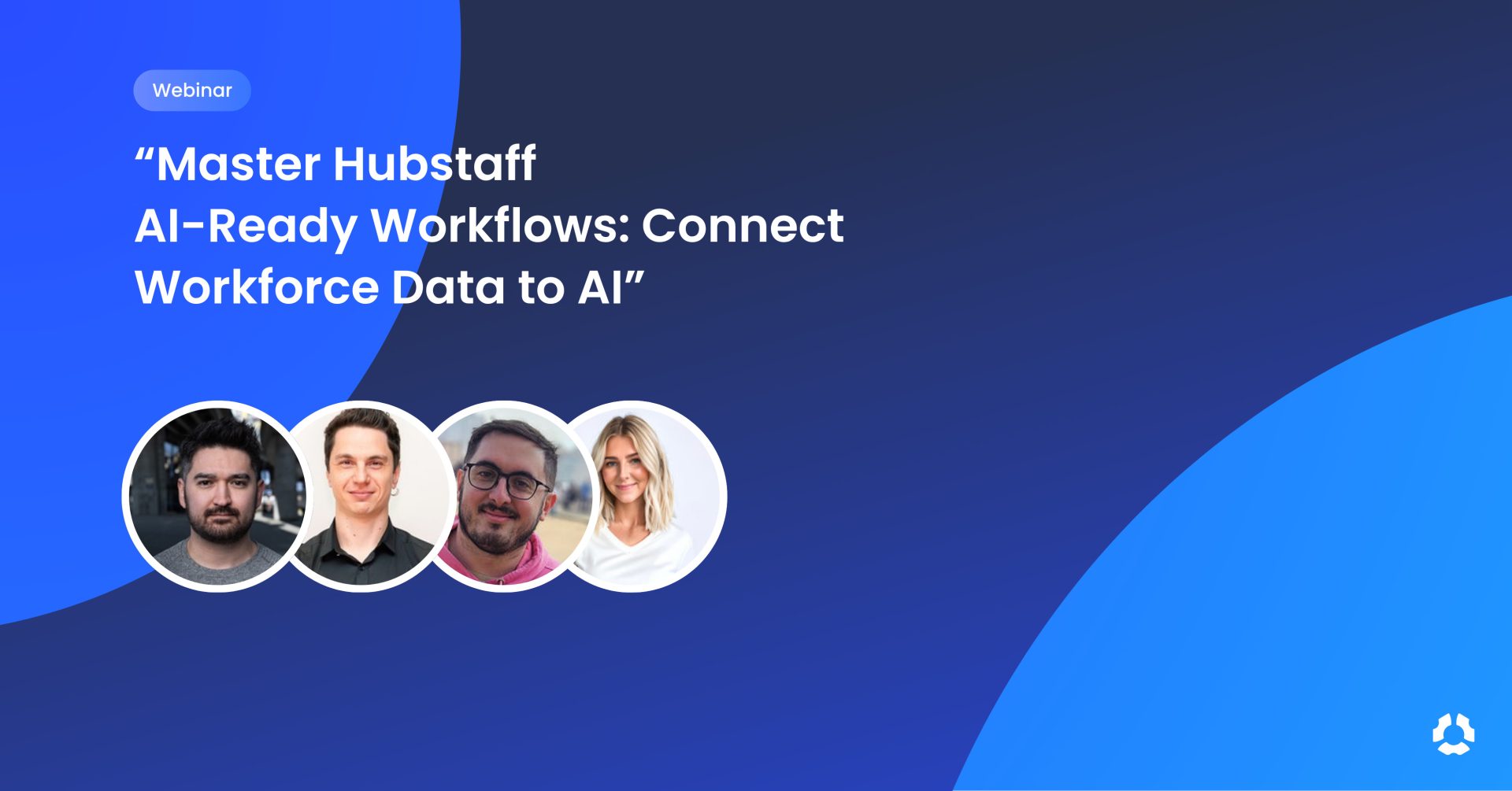
We hosted a webinar to show a better way: connecting AI directly to your Hubstaff data. Aubrey Nekvinda, our Product Marketing Manager, moderated. Presenting were Jeff and Jean, both product managers at Hubstaff, and Hugo, a developer on our product team.
When we polled attendees on their biggest team management challenge, two answers led the pack: fear of missing something important, and digging through too much data to understand what’s really going on. Every workflow in this session targets one or both.
You can watch the full recording below or read on for the key takeaways.
Stay in the loop
Subscribe to our blog for the latest remote work insights and productivity tips.
Three ways to work with your data
Jeff opened with the framework for the whole session. The public API is the bedrock, the main gateway for accessing your Hubstaff data programmatically, and the most flexible option of the three.
Two newer tools sit on top of it, built specifically for AI-enabled workflows:
- The CLI (command line interface). It turns API endpoints into commands you can run directly, with no extra tooling to install. It also handles token refresh automatically, which anyone who has managed API requests by hand will appreciate.
- The MCP (Model Context Protocol) server. A connector that makes your Hubstaff data readable by AI assistants like Claude or ChatGPT, designed for questions asked in natural conversation.
One distinction matters across all of them: read versus write. Read operations pull data out of Hubstaff, like tracked time, activity, and limits. Write operations make changes, like creating a schedule or adding a time off request.
The MCP is read only by design, so nothing you ask an AI assistant can trigger an approval or a payment. Access always follows your existing Hubstaff role, which means nobody can see more through the API than they can in the app itself.
Combining tools to answer profitability and staffing questions
Jean’s section centered on a simple observation: the most valuable business questions usually span more than one tool. He walked through two of the questions customers use the public API to answer.
Which of my clients are actually profitable? If you run an outsourcing or professional services company, the answer requires an effective hourly rate: what a client pays you divided by what their hours cost you. Your CRM knows the first number, and Hubstaff knows the second. Neither can answer alone.
Jean showed a dashboard built with the public API that joins both into one table. In his example, Harbor Line Media looked like the top client based on contract value, and the effective rate calculation told a different story: it was well below the average customer.
How much time do managers spend chasing people? Hubstaff’s “Who’s online” widget shows which team members are tracking time. The reason someone isn’t tracking usually lives in your HR system.
In Jean’s demo, the time tracking data alone showed four people not working, which would mean four check-in messages from their manager. Once the HR data came in, three of them turned out to be on approved leave. The manager contacts one person, and nobody gets pinged in the middle of a private leave.
This second workflow also used a write operation to sync the HR system’s time off requests back into Hubstaff. That’s the difference between a report and an integration: a team lead with no dashboard access still sees the time offs right where they already manage their team.
To start building, head to the developer portal at developer.hubstaff.com. It covers setup for both tools, and the CLI includes 175 commands plus a built-in help command that lists every filter and option.
Two more points from Jean worth keeping:
- Everything can be automated. Hand your IT team the requirements, and they can build a workflow that runs on a schedule and keeps your dashboard permanently up to date.
- An AI assistant can drive the CLI for you. The developer portal is optimized for both humans and LLMs, so an assistant can guide you through commands even if you’ve never touched a terminal.
Asking one-off questions with the MCP server
Hugo took over for a live demo of the MCP server inside an AI client. He ran three questions against a sample organization, all in plain language:
- Should this time off request be approved? The AI pulled the request, checked it against the rest of the team’s schedules, and found an overlap that would leave zero coverage for several days. It then proposed alternative dates and verified they’d actually work.
- Did anyone forget to start their timer last week? The AI compared expected schedules against tracked hours and flagged the exact team member and date Hugo had planted as the test case.
- How balanced is our billable and non-billable time? The AI broke the ratio down by person and across the organization, flagged one team member working entirely on non-billable projects, and then correctly recognized from context that he was a recent hire still in training.
Hugo was direct about where each tool fits. The MCP shines for exploration, quick iteration, and questions you don’t need to ask every day. Recurring workflows on a schedule belong to the CLI and public API.
The MCP can also run alongside MCP connectors from other tools in the same AI client, so you can pair your Hubstaff data with a third-party system even without a direct integration.
Availability and getting started
The public API and CLI are available on Team and Enterprise plans, and the MCP follows the same rule. The MCP is in early access and will roll out to everyone soon. To get access now, reach out to our support team, and listings in the major AI clients’ connector directories are on the way.
A few useful answers from the Q&A:
- Webhooks are supported. The developer portal has a dedicated section covering setup, testing, and every available event.
- API access mirrors your permissions. A user role sees only their own data, and an organization manager sees exactly what your permission settings allow. Nothing more opens up through the API.
- You can provision accounts before someone starts. For new contractors, the API can create the account, set project assignments, and keep tracking disabled until day one, then flip it on when they’re ready.
Ready to put your data to work?
Explore the public API and CLI on the developer portal, or reach out to our support team for MCP access. If you’re not using Hubstaff yet, start a free trial and see what your team’s data can tell you.
Most popular
The Best Coaching Conversations Start With Productivity Data
Most coaching conversations happen too late. A deadline is missed, or a client flags a problem, and then a manager schedules a sit...
A Quick Guide to Work Order Management
From quick fixes to long-term stability, work orders are crucial to asset management and helping managers keep operations running...
How to Identify High Performers Using Work Patterns
Every business has top performers, and managers are told to find them all the time. But in most cases, they default to approaches...
The AI Productivity Panel: Lessons From Leaders on What’s Working (and What’s Not)
When I moderated this AI productivity panel, I expected a solid conversation. What I didn’t expect was the flood of real-world i...