A field service manager exploring Hubstaff workforce productivity features on a tablet at a job site
guide

What is Workforce and Workplace Productivity?

What is workforce productivity? Is it the same thing as workplace productivity?

They sound similar, but they’re different.

Workforce productivity measures the output of goods and services a team can produce in a given time frame. Workplace productivity, on the other hand, looks at the conditions, environment, and systems that make that output possible.

Together, the two concepts tell a more complete story than either one does alone.

With remote and hybrid work now the norm for millions of teams, understanding what drives output has real consequences for how businesses grow.

According to the Bureau of Labor Statistics, productivity grew by 2.5% in Q4 2025. However, the meaning of "productivity" tends to change depending on who you ask. So what does productivity look like in the modern workforce? 

In this guide, you’ll learn about both workforce and workplace productivity — what the terms mean, how to measure them, and how to improve them. Let’s get started.

What does "workforce productivity" mean?

Workforce productivity is the measure of how much output a team or department produces relative to the time and resources they put in.

In simple terms, workforce productivity is about maximizing output relative to inputs like the number of people, hours worked, and equipment used.

At a team and department level, this connects directly to labor productivity. When each person's contribution adds up efficiently, the whole organization moves faster.

For remote and hybrid teams, that equation gets more complex because output isn't always visible in the traditional sense. The conditions in which each person is working can significantly vary as well.

Tracking workforce productivity supports business leaders in making better decisions in hiring, tooling, and structuring the team’s work.

stocksy_txp6a7ce083ej3300_small_779866-1.jpg

How do workplace productivity and workforce productivity differ?

Workplace productivity is the definition of how well the environment, systems, and conditions of a workplace enable people to do their best work.

Where workforce productivity focuses on the output of your people, workplace productivity focuses on the conditions that surround them. 

This means the physical or digital space, the tools, the culture, and the structure of the workday. They're related, but they pull on different levers.

Workforce ProductivityWorkplace Productivity

What it measures

Output of people and teams

Quality of the environment and systems

Focus

Efficiency of labor

Conditions that enable work

Key drivers

Skills, engagement, processes

Tools, culture, space, leadership

Applies to

Individuals, teams, departments

The organization as a whole

Example metric

Revenue per employee

Employee satisfaction score

Neither concept works well in isolation. A highly capable team stuck in a poorly designed work environment can still underperform. Conversely, a beautiful workplace means little if the people in it aren't engaged, equipped, or clear on what's expected of them.

Why are workforce productivity and productivity in the workplace important?

Poor workforce productivity harms an organization's competitiveness and profitability. Enhancing workforce productivity is a goal for any business owner, but what do companies stand to gain with labor productivity growth?

Business leaders must determine which factors improve performance and output, and which workflow patterns hurt profitability. That means looking at both the people doing the work and the environment in which they're doing it.

Our data shows that there is productivity growth for remote teams. The average remote employee spends 4.15 more hours in a focused state of work each week, about a 22% gain compared to the average in-office worker.

Workplace productivity plays a significant role here. The right conditions, tools, and structure determine how conducive your workplace is to focus time.

By building a productive workforce and a workplace that supports it, you can also:

  • Enhance employee engagement.
  • Foster a positive work environment.
  • Boost employee morale and motivation.
  • Increase employee productivity.
  • Find better ways of working.
  • Improve working conditions.
  • Enable remote work and flexible working conditions.
  • Improve decision-making.
  • Increase profitability.
  • Improve staff retention.

Improving workflows and human capital support produce positive results. Of course, results depend on what you do and how effectively you do it.

Minor changes are easier to make but have less impact. Large-scale policy changes (like implementing new software to automate jobs) can take longer but pay off in the long run.

How to measure labor productivity

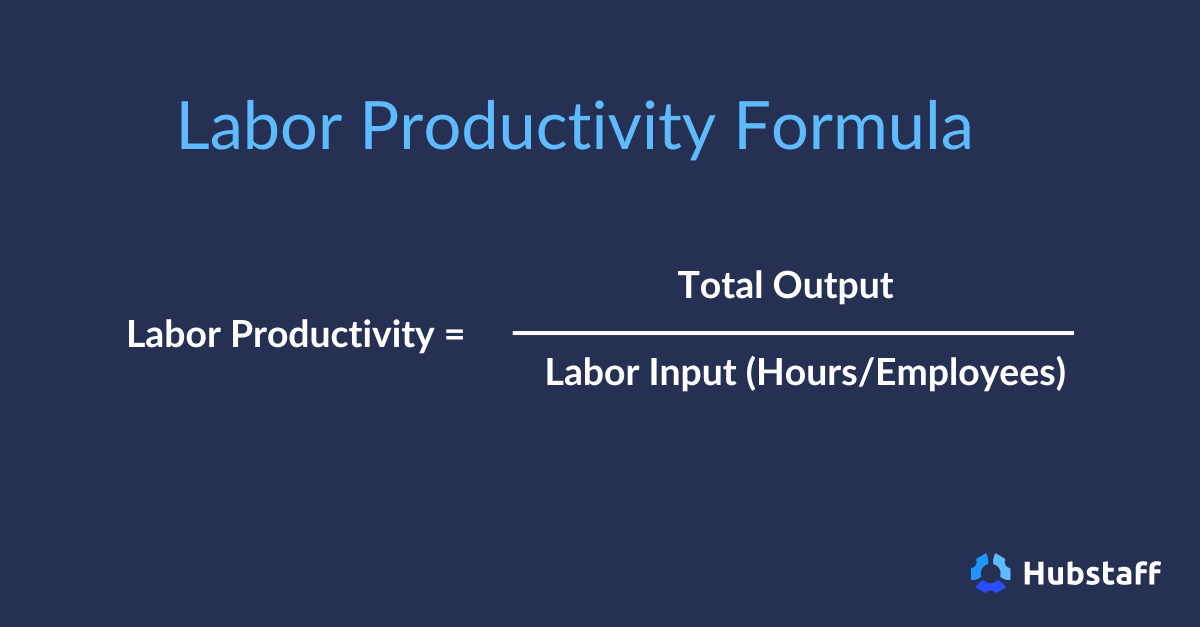
Whether it’s at the workforce or workplace level, measuring labor productivity is what separates informed decisions from educated guesses. 

It’s difficult to spot bottlenecks or make budgeting decisions if you don’t understand what is and isn’t working. Keeping track of your employees' productivity lets you see the big picture, allowing you to determine where your current workflow and policies influence productivity.

By looking at metrics carefully and tracking them over time, companies can make decisions that boost workforce productivity.
Labor Productivity Formula.png

How do you measure workforce productivity?

Measuring workforce productivity starts with establishing individual or departmental performance metrics, but it's not as simple as it may sound. Your key performance indicators (KPIs) will depend on the type of work you do. 

 In manufacturing, output is straightforward: units produced per hour, defect rate, or throughput. In knowledge work, it's less visible because you're looking at things like tasks completed, project cycle time, and revenue per employee.

For example, if you want an accurate metric for workforce productivity, consider defining and measuring tasks, not just hours worked.

Employers can set reasonable goals and expectations for each department or position with the right metrics. They'll also need a way to keep track of those goals.

Some business leaders use software to track workforce productivity.

Platforms with workforce management features show metrics about workforce productivity in real time.

  • See real-time updates on how many hours each team member has worked.
  • Find out what apps and tools your team is using.
  • Identify productive and unproductive apps and websites.
  • Track tasks and projects and move them forward.
  • Set and track productivity benchmarks.
  • Celebrate team members who have made the team more productive.

Start with one or two meaningful indicators per role, build a baseline, and let the data tell you where to focus next.

How do you measure workplace productivity?

Measuring workplace productivity means looking beyond individual output and asking whether the environment itself is set up for people to do their best work. The metrics here tend to be broader, but they're just as trackable.

Common examples include: 

  • Output based on hours worked
  • Revenue per employee
  • Tasks completed vs. hours logged
  • Utilization rate
  • Error rate
  • Revision rate
  • Customer satisfaction scores
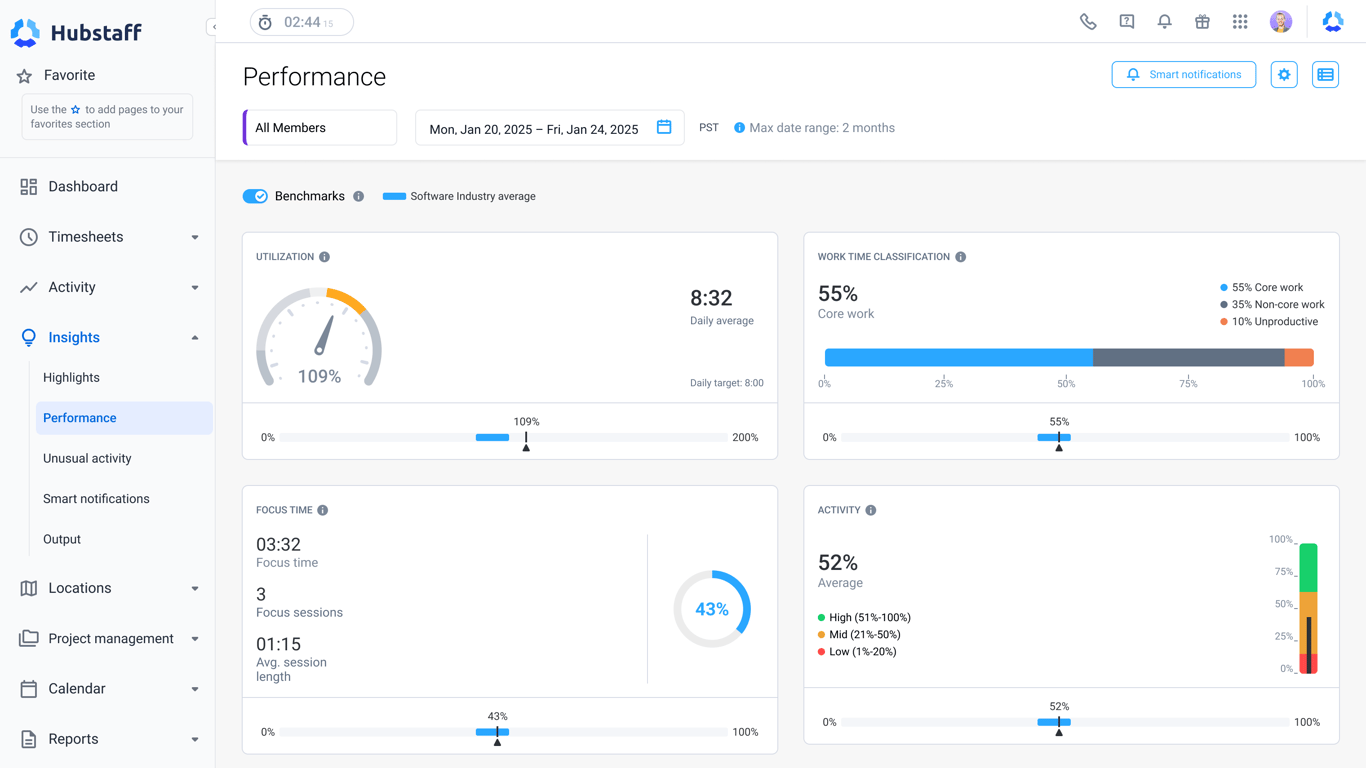
utilization.png

In our 2026 global trends and benchmarks report, we gathered data from 140,000 workers and found that focus time varies significantly by role and workstyle:

  • The average person spends around 39% of their tracked time in genuine deep focus.
  • High-focus roles like engineers, analysts, and designers reach 40-44%.
  • Highly collaborative roles often fall below 30%.
  • A healthy productivity rate is generally considered to be above 70%.
  • Office-based teams log the highest focus share at 45%, compared to 41% for remote and 31% for hybrid teams.

The challenges are real. Distributed and hybrid teams make workplace productivity harder to see, and without the right tools, managers are often working from instinct rather than data.

Hubstaff helps a lot here by giving teams a real-time view of how work is getting done, where time is going, and where the conditions for focus are breaking down before it becomes a bigger problem.

How often should productivity metrics be reviewed?

How often you review workforce and workplace productivity depends on your preference and how you are measuring it.

Some metrics, like focus time or tasks completed, are worth checking weekly, while broader indicators like revenue per employee or employee satisfaction are better reviewed on a monthly or quarterly basis.

Organizations need to keep a close eye on proof of work and the overall productivity of their employees — especially if they have a high turnover rate, a low ratio of hours worked to output, or need to improve performance.

The same applies to workplace conditions. If engagement is slipping or focus time is trending down, catching it early gives you a much better chance of addressing it before it compounds.

Key factors that influence productivity

Productivity doesn't happen in a vacuum. Whether your team is in an office, fully remote, or somewhere in between, the same underlying factors tend to determine how much meaningful work gets done in a sustainable manner.

  • Work environment and ergonomics. Physical comfort, workspace design, and access to the right tools affect output more than most leaders account for. A poorly set-up home office can be just as limiting as a noisy open floor plan.

  • Employee engagement and morale. Engaged employees are more focused, more consistent, and less likely to leave. Low morale is a major drain on productivity, and it often goes on for a while before being detected.

  • Skills and professional development. Teams that are given room to grow tend to find better, faster ways of working. Stagnation in skills usually means stagnation in output.

  • Technology, automation, and AI. Using the right tools reduces friction and frees up time for higher-value work. AI tools, in particular, are becoming increasingly capable of handling repetitive tasks. However, they only truly shine when properly integrated into workflows.

  • Culture and leadership. How leaders model focus, set expectations, and respond to underperformance shapes the entire team's relationship with productivity.

  • Distractions. Notifications, unnecessary meetings, and context switching hinder focus across every office type. All team configurations face this, just in different forms.

Understanding these factors is the first step. The second is knowing which ones move the needle for your team specifically, and being honest about which ones you're currently ignoring.

How to increase employee and team productivity

A great place to start exploring ways to increase employee and team productivity is to carefully consider your organization's workflow, culture, and workplace environment — whether that's a physical office, a fully remote setup, or something in between.

Here are six things you can do:

1. Set clear goals and expectations 

Productivity without direction is just meaningless activity and hardly productive at all. Make sure every team member understands what they're working toward, how their output will be measured, and what success looks like at an individual, team, and department level.

For hybrid and remote teams, especially, a shared understanding of goals is what typically separates high-performing distributed teams from ones that feel perpetually misaligned.

2. Optimize the work environment

Check in with your team to find out their working conditions.

Each team member should have access to a user-friendly environment that supports focus. That could be an ergonomic home office setup, a well-designed in-office space, or access to coworking facilities.

Make sure that technology needs are met, physical workspaces are comfortable, and that people are taking regular breaks.

3. Empower employees through training, tools, and autonomy

Make a good training and professional development policy so that every worker has the skills to do their job. Training empowers and prepares team members for promotion, promotes morale, and encourages continuous productivity.

Beyond training, give people the autonomy to decide how and when they do their best work. It’s particularly important for remote and hybrid employees, as the way they break up their schedule can have an impact on their productivity. 

4. Leverage technology and automation

Your business can save time and money by automating tasks with software like Hubstaff.

The right technology frees up time for higher-value work and keeps distributed teams aligned without adding unnecessary meetings or check-ins. AI tools can more than handle repetitive tasks, but the gains only show up when they're built into daily workflows.

dashboard-time-2x-2.png

5. Foster a culture of continuous improvement and wellbeing

Employees who are happy with their jobs stay longer and do better work. Team-building, which could be in the form of remote retreats, informal Slack channels, or structured recognition programs, helps keep people engaged and morale high.

A helpful human resources department, competitive salaries, and meaningful benefits all reinforce the message that the organization is invested not just in the output, but in the people behind that work.

6. Monitor and iterate with data and feedback loops

Adopting new tech is one thing, but knowing if it is or isn’t working is another. 

Workforce management platforms can track productivity metrics in real time, identify patterns, and make adjustments before small issues become bigger. To support this, build in regular feedback loops with your team so that the people closest to the work can flag what's slowing them down.

The role of productivity in the modern workplace

The way work is organized has changed more in the last five years than in the previous twenty, and most productivity frameworks haven't kept up.

Remote, hybrid, and distributed teams are now how a significant portion of the global workforce operates, and the old proxies for productivity like hours at a desk and attendance in meetings no longer tell you much about what's getting done.

For distributed teams, working conditions are often the first wall. Tool overload and fragmented communication impede meaningful output, but lack of focus time is a huge factor, too. 

If you want to achieve real, sustainable productivity in your team, try a free, 14-day trial of Hubstaff. It gives leaders a ground-level view of how work flows across their organizations, with valuable metrics like focus time, meeting load, and utilization rates across roles.

Are you ready to raise productivity levels for your workforce?

Sign up now to get a 14-day free trial.

Try Hubstaff now