AI Went Wide, Not Deep – and That’s the Real Problem

 3 min read
- AI adoption rates are misleading — Hubstaff's 2026 Global Work Index shows AI app usage dropped from 4% to 3% of tracked time, proving access doesn't equal meaningful impact.
- Engineers using AI spend ~8% of their time in AI tools — more than double the average — because they protect focus time and embed AI into workflows instead of using it reactively.
- Tracking AI licenses and adoption rates misses the real driver of ROI; leaders should measure focus time to understand whether conditions exist for AI to deliver compounding gains.

Leaders are measuring AI adoption, but they really should be measuring focus time.
On paper, AI adoption is impressive. Most organizations can point to rollout numbers, internal announcements, and training session attendance. Teams say they’re “using AI.” By most traditional metrics, progress is happening.
But the impact leaders expected isn’t materializing.
Our latest benchmark data shows why. This analysis is based on data from the 2026 Global Work Index, which tracks how 140,000+ global workers use AI tools in real-world work environments.
While AI adoption increased year-over-year, the share of total tracked time spent in AI apps actually slipped from around 4% to 3%. More people have access, but fewer workers are spending meaningful time with AI tools.
What “wide” really means
“Wide” means more people have access to AI. They prompt. They summarize. They draft. They experiment.
But “deep” would mean something different. It would mean AI is carrying a real share of the work — embedded into workflows, shaping output, not just speeding up small tasks.
Right now, most teams are wide. Very few are deep.
This isn’t a technology problem, it’s a depth problem. Your team’s AI use is too shallow.
Stay in the loop
Subscribe to our blog for the latest remote work insights and productivity tips.
The gap isn’t access. It’s focus.
AI has spread wide across organizations without being anchored to the work that defines performance or makes business impact. A team member who prompts four or five times a day is technically using AI. Helpful, yes. But ultimately surface-level.
What we’re seeing now is less a wave of transformation and more assistance layered on top of existing processes.
Even within systems that were never designed to take advantage of it, AI helps people move a little faster. The ceiling stays low because the workday hasn’t changed.
But there are notable exceptions that can teach leaders how to use AI better.
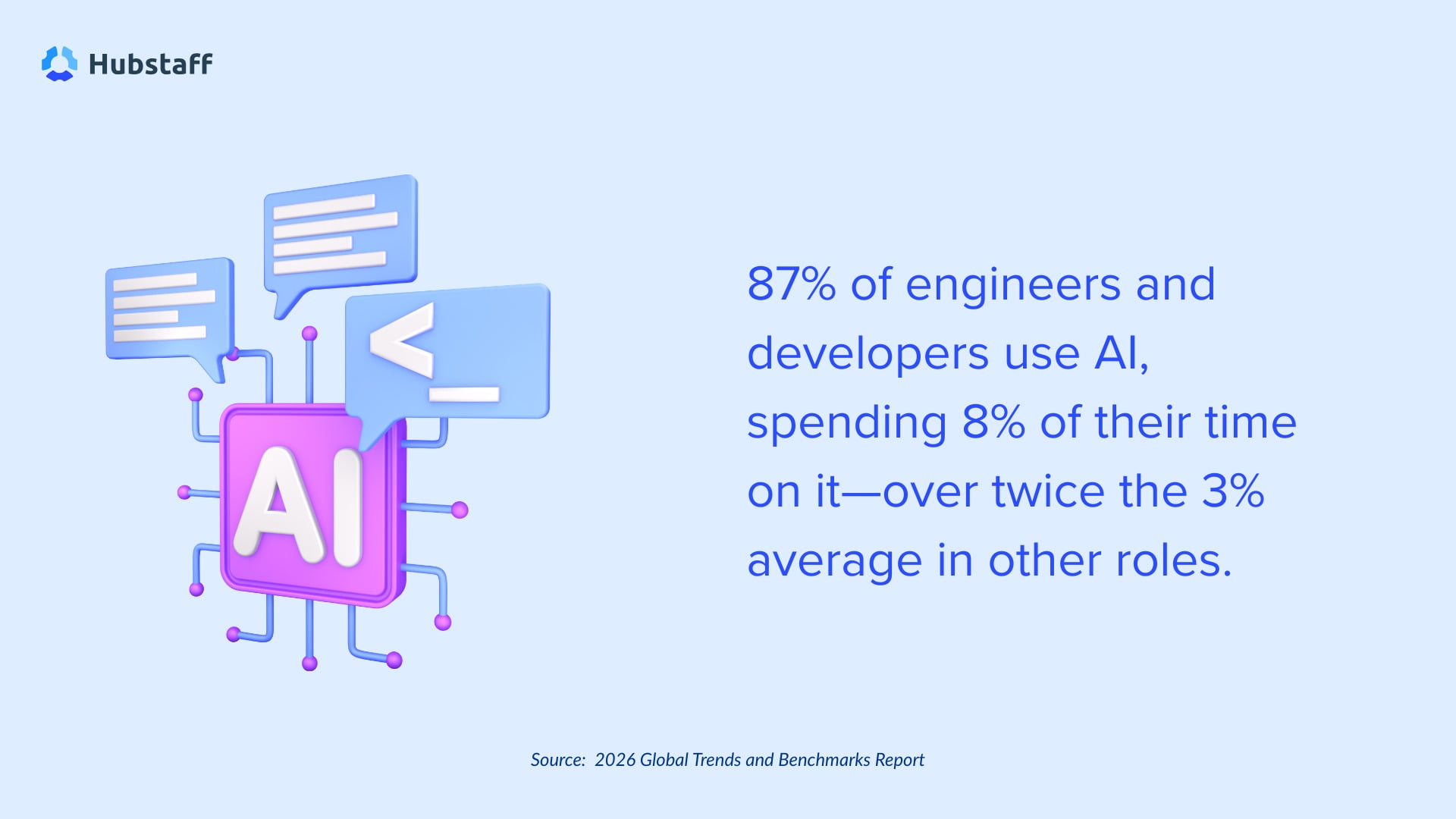
Among engineers and developers, 87% have adopted AI tools, and they’re spending roughly 8% of their time using them; more than double the 3% average across most other roles. That difference is not about enthusiasm. It’s about the environment.
Engineering teams are more likely to protect uninterrupted time. They experiment. They iterate. They embed AI into their workflows instead of tapping it between meetings.
Depth requires space.
Teams are tracking the wrong metrics
Teams can track things like active licenses for AI tools and adoption rates, but those metrics don’t answer the most important question: Is AI being used deeply enough to change outcomes?
The missing variable is focus time.
AI cannot deliver meaningful gains if used with fragmented attention. It doesn’t thrive in between meetings, notifications, and status updates.
Like any tool that meaningfully augments skill, it demands space. It requires sustained engagement with real work, not just bursts of interactions.
When attention is fragmented, AI becomes an add-on. When focus is protected, AI becomes integrated.
Until companies are willing to confront that and until they stop treating AI as an overlay and start rethinking how work flows, results will plateau. Not because AI lacks potential, but because organizations are unknowingly capping it.
Measuring AI adoption isn’t enough
Measuring AI adoption isn’t a wrong move, but it’s just a starting point.
Adoption metrics say nothing about how people use their time. They don’t reveal how often work is broken into fragments, how much energy is spent context switching, or how rarely people get the kind of uninterrupted stretch they need to make the most of AI.
AI requires sustained attention to deliver real gains. So, for leaders, the question becomes not who has access, but who has the conditions to go deep. Who can think without interruption? Who can experiment without racing the clock? Who can let one good output feed the next?
Most importantly, who has focus?
In most cases workdays aren’t structured for depth. They’re structured for availability. In that environment, it’s not surprising that AI is used in small, convenient ways rather than as a foundation for compounding efficiency.
You can continue investing in better AI tools. But if workdays are carved into fifteen-minute pieces, those tools will only ever touch the surface of the work.
AI didn’t fail to change work. We failed to measure the one thing that determines whether it can.
Explore benchmarks on focus time, AI usage, and productivity patterns across 140,000+ workers in our latest benchmark report.
Most popular
The ROI of AI in Workforce Tools: Measuring Business Impact in Distributed Teams
It’s hard to pinpoint the exact moment AI became the standard in tech, but it’s a bit strange to picture a time before it now....
7 Tools That Help Teams Monitor AI Usage at Work in 2026
AI is everywhere. Adoption continues to grow, but from monitoring AI usage, we’ve learned that daily use is still a mixed bag, a...
Hidden AI Usage in the Workplace: What Your Tools Don’t Tell You
How much has AI changed your team’s work? On the surface, work might not look that different. The meetings are still there, docu...
How Many Meetings Are Too Many? 2026 Benchmarks by Role
How many meetings are too many? In 2026, the honest and boring answer is: it depends on your role. Our 2026 Global Trends and Benc...