How AI Companies Scale Distributed Teams Without Losing Control

 5 min read
- Scaling AI teams requires cross-platform visibility across tools, vendors, and workflows — without it, poor data silos can cost organizations an average of $12.9 million annually.
- High-performing AI teams separate billable client work from internal R&D, automate repetitive processes via APIs, and use utilization analytics to manage throughput and capacity at scale.
- Hubstaff's time tracking and AI-powered workforce analytics give leaders real-time visibility into productivity, accurate automated timesheets, and audit-ready reports across distributed teams.

To scale AI teams, you’ll need to take a fundamentally different approach than other businesses. Unlike traditional SaaS teams, AI organizations don’t work from a single system. That’s why AI leaders and operators need clear visibility across tools, vendors, and workflows to scale teams without losing control.
Behind every model is a network of contributors:
- Annotators labeling data
- Evaluators validating outputs
- Consultants deploying in client environments
- Engineers shifting between experimentation and R&D
This creates a non-linear, interdependent workflow where progress depends on continuous feedback loops. As teams scale, leaders lose visibility into who’s doing what, where time is going, and whether work is even billable.
Let’s explore the unique challenges to managing geographically distributed teams and practical strategies that help AI companies scale while maintaining visibility and control.
Hubstaff Walkthrough
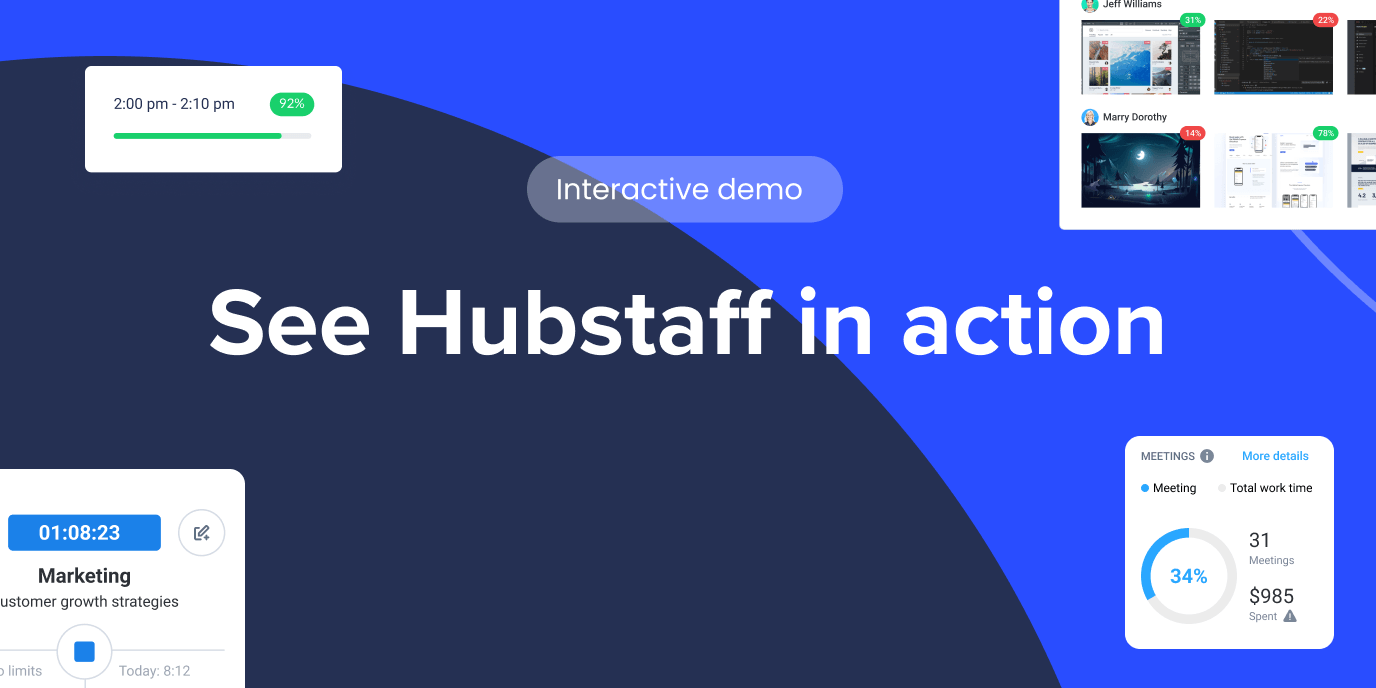
Dive into our interactive demo and explore the features that make managing global teams easier than ever.
Why traditional operations break at AI scale
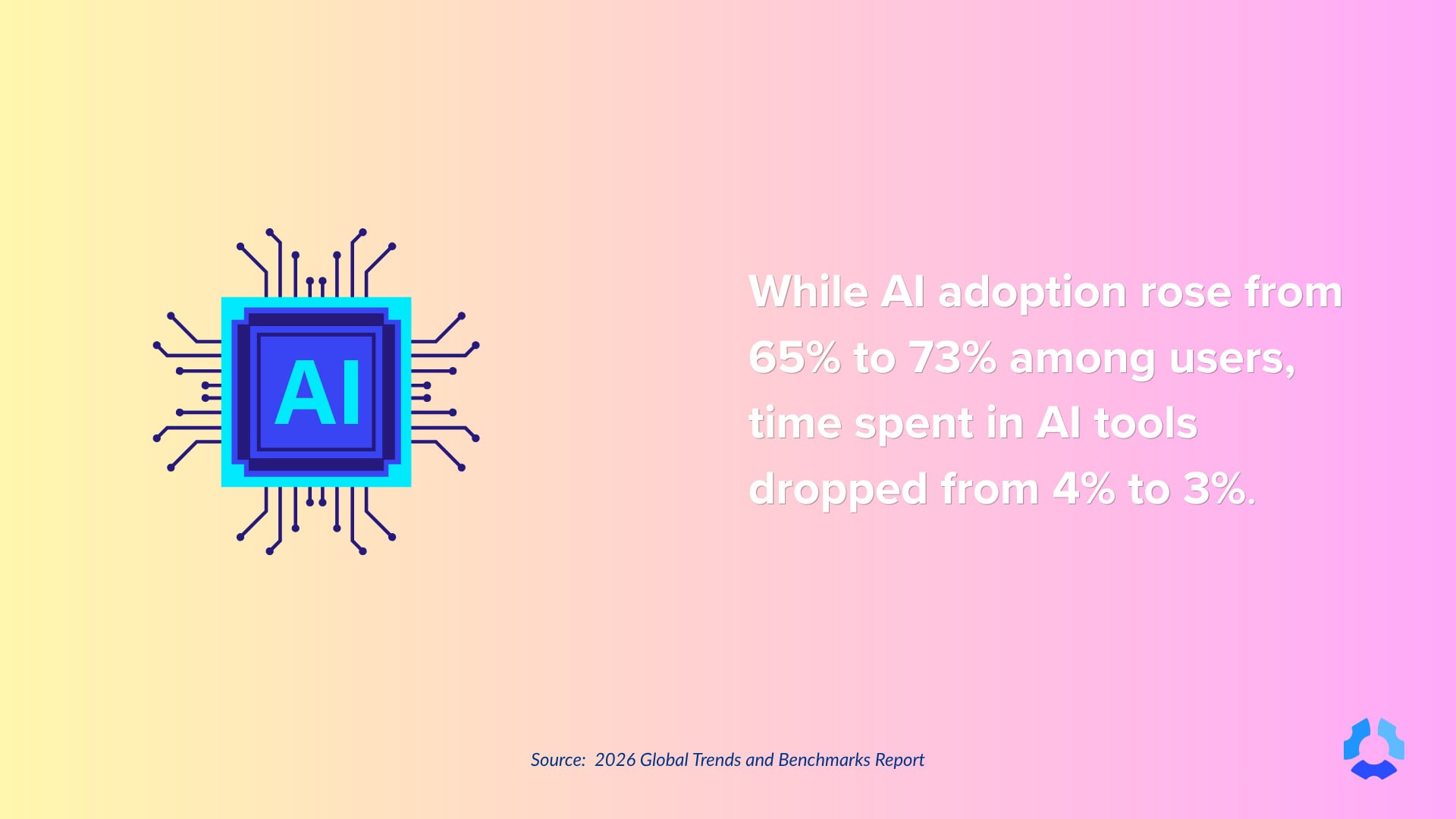
While AI adoption rose from 65% to 73% among users, time spent in AI tools dropped from 4% to 3%, indicating increased usage without deeper integration.
From this data, one could deduce that many teams still use manual workflows. However, work in AI teams often happens in parallel, and manual processes frequently disrupt this flow.
In practice, AI teams are running multi-system workflows on top of infrastructure that wasn’t designed for them.
Manual timesheets are a clear example of the problem. They don’t reflect how contributors actually work, moving between internal systems and client environments. In fact, up to 80% of timesheets require corrections when using manual systems.
When the record of internal and billable client time is inconsistent, processing accurate payment for the work done becomes difficult.
At scale, these gaps compound:
- Work spread across platforms creates silos and reporting blind spots.
- Contributors operating inside client systems make time tracking harder to standardize.
- Work record requirements increase friction in billing and audits.
- API complexity grows as teams automate onboarding and provisioning across tools.
- Utilization becomes unclear, making capacity planning unreliable.
As operations become more distributed, faster, and harder to control, leaders are left to make decisions without the full picture.
The risks of scaling without visibility
Scaling without visibility comes at a cost, and it escalates quickly. As AI enterprises grow across distributed teams, tools, and locations, the lack of structured operational visibility starts to impact both financial performance and execution quality.
Research shows that poor data visibility and silos cost organizations an average of $12.9 million annually, underscoring how quickly inefficiencies scale.
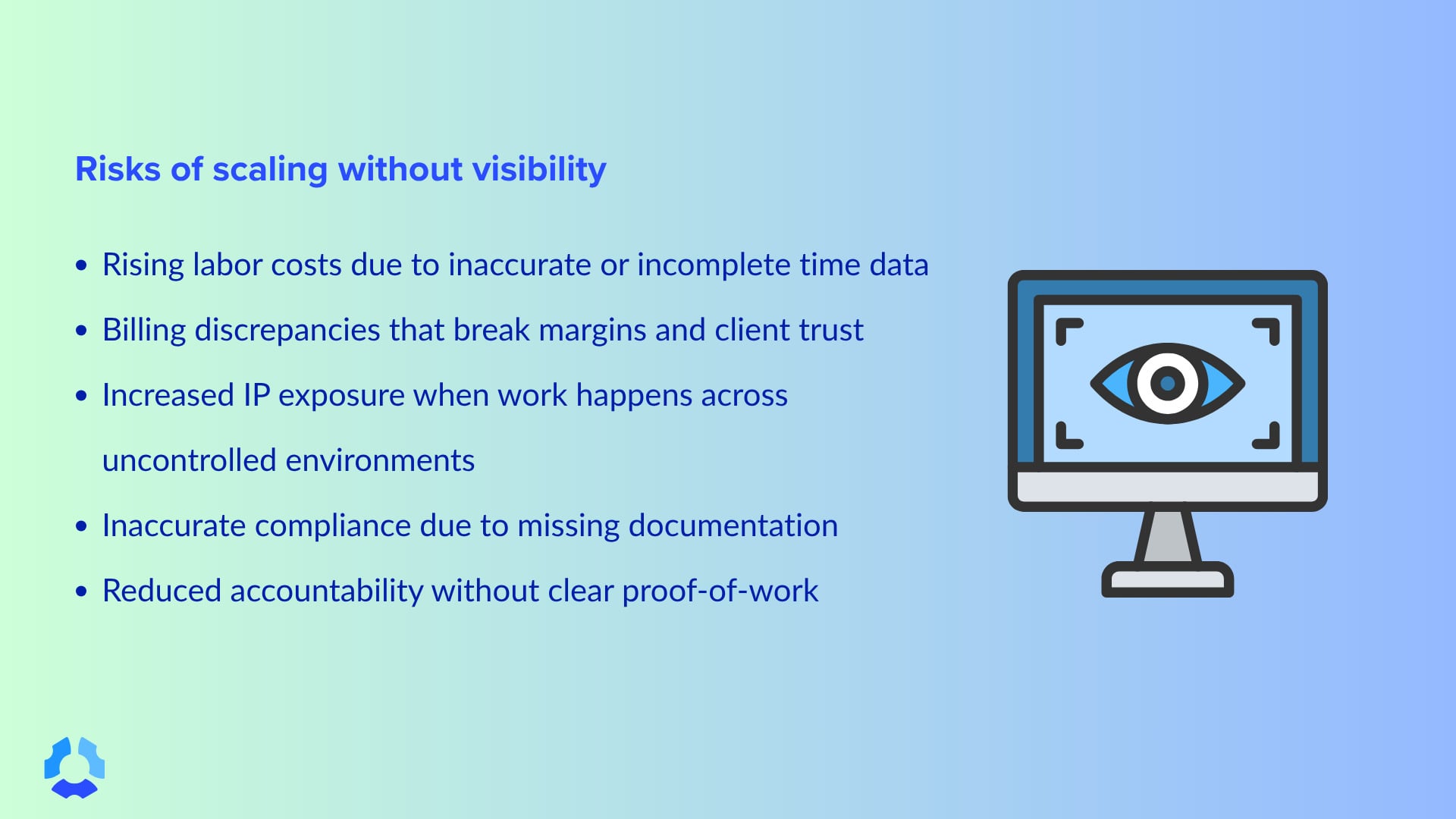
In practice, the risks show up across the business:
- Rising labor costs due to inaccurate or incomplete time data
- Billing discrepancies that break margins and client trust
- Increased IP exposure when work happens across uncontrolled environments
- Inaccurate compliance due to missing documentation
- Reduced accountability without a clear record of work
For AI companies operating at scale, visibility carries both significant financial impact and operational consequences. Without it, leaders are left managing distributed teams with partial data and delayed insights, increasing risk across every layer of the business.
What high-performing AI teams do differently
Whether managing distributed engineering teams or contractor networks, high-performing AI teams build systems that make work visible, measurable, and scalable.
For these teams, work is not left to interpretation. They focus on clarity across workflows, tasks linked to outcomes, and outcomes that drive real impact. This makes performance easier to track and ROI easier to understand.
As a result, contributions don’t get lost. Teams can see how their work connects to larger business goals to improve alignment and accountability.
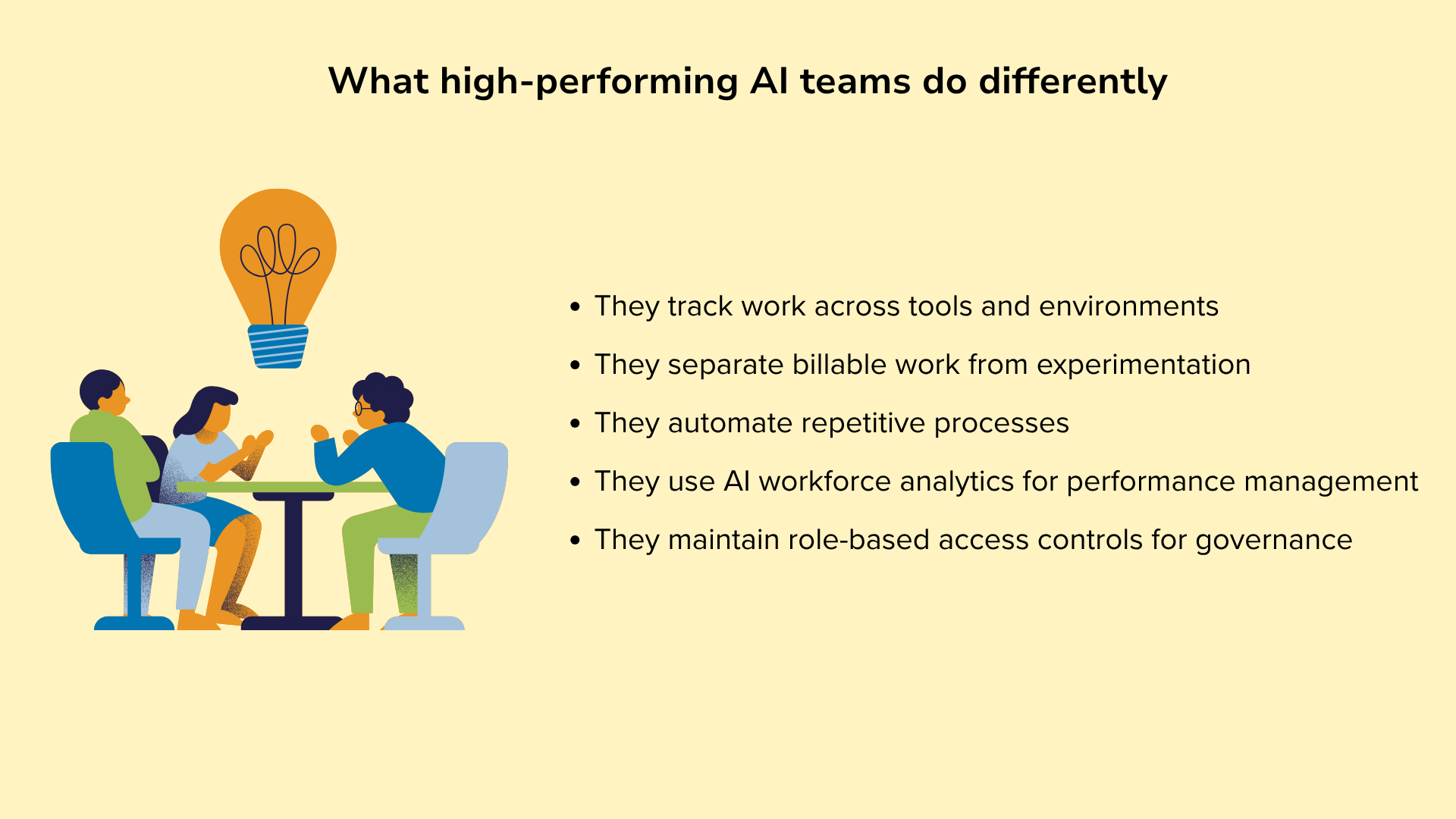
A few principles set strong distributed AI teams apart:
- Cross-platform time visibility: They track work across tools and environments, ensuring output is measurable and aligned with workforce capacity.
- Clear project segmentation (client vs. internal R&D): They separate billable work from experimentation, so efforts don’t distort delivery timelines or profitability.
- API-driven automation and provisioning: Instead of manual workflows, they automate repetitive processes, integrating AI directly into daily workflows.
- Utilization analytics to track throughput: They use AI workforce analytics for performance management, not just activity, focusing on throughput, efficiency, and team capacity.
- Role-based access controls for governance: They ensure the right people have the right level of access, maintaining control as AI adoption scales.
The common thread is intentional system design. These teams treat workflows as infrastructure, which allows them to scale without losing control.
The operational advantage of visibility
Operational visibility helps AI teams understand how work happens across systems, contributors, and client environments.
AI time tracking data plays a key role, providing more than hours worked. It highlights workload patterns, utilization, and performance trends.

Leaders no longer rely on updates or incomplete reports. With AI workforce analytics, they get a real-time view of progress, output, and team performance. Contributors also benefit from structured, compliant records of work, which clarify expectations and help ensure accurate payment.
This is especially important in AI teams, where work often spans multiple systems.
Contributors may:
- Move between internal tools and client environments.
- Work across multiple projects in parallel.
- Switch between tasks like annotation, validation, and QA.
With visibility in place, teams can:
- Have visibility without micromanagement: Leaders rely on objective signals like tracked time and proof-of-work instead of constant check-ins.
- Scale contributor networks: Distributed taskers and contractors can be managed consistently, as they move between client platforms and internal systems.
- Bill accurately: A clear separation between internal and client work ensures accurate billing and cost alignment.
- Access audit-ready reports: Every hour worked is tracked, validated, and easy to report on.
- Build compliance and trust: Transparent workflows and reporting reduce friction in billing and compliance, improving client relationships.
In practice, teams can manage large contractor networks, automate onboarding through APIs, and use AI-driven insights to evaluate performance. All while tracking work across platforms and maintaining accurate reporting.
Bringing visibility into your workflows
Managing a distributed AI team without visibility is like running operations in the dark. You know work is happening, but you can’t clearly see where time is going or what’s getting done.
Whether your team works inside internal systems or across client environments, you need infrastructure that captures every hour, every action, and every output.
Employee time tracking platforms like Hubstaff include built-in productivity tracking that helps leaders understand how work happens during the day. Features like keyboard and mouse activity levels, app and URL usage, and optional screenshots encourage transparent monitoring, keeping teams aligned and compliant in remote environments.
Logged hours are automatically converted into timesheets, keeping payments accurate. At the same time, AI-powered workforce analytics give leaders real-time insights into productivity and utilization across projects.
This means:
- Time is tracked accurately across tools and environments.
- Activity and productivity patterns are clearly visible.
- Reports are reliable and ready for billing or audits.
With API integrations and structured reporting, this visibility becomes part of the workflow, not something extra to manage. When work becomes measurable, utilization is clear, and eams can scale with confidence without losing control.
FAQs
What does it mean to scale teams?
Scaling teams means increasing output and capacity without a proportional increase in complexity or cost. For AI companies, this often involves growing distributed contributor networks, managing work across multiple platforms, and maintaining visibility as operations expand.
Why do companies fail to scale?
Most companies fail to scale because their operations don’t advance with their growth. They still operate traditionally. Manual workflows, poor visibility, and scattered systems make it difficult to track work, manage contributors, and maintain consistent output, especially in fast-moving AI environments.
What are the 4 pillars of scaling up?
The four pillars of scaling are people, process, technology, and data. For AI teams, this translates into:
- Managing contributors effectively
- Standardizing workflows, integrating systems (often via APIs)
- Using reliable data to drive decisions around utilization, performance, and growth
Most popular
How to Spot and Manage Work Overload Before Your Best People Burn Out
Work overload occurs when the demands placed on an employee or team exceed their available resources, leading to stress, burnout,...
Workplace Productivity Statistics in 2026: What the Numbers Say
For many businesses, having the ability to maximize output without compromising quality gives them a major edge over their competi...
Time Doctor vs. ActivTrak: Which Tool Is Right for Your Team?
Time Doctor and ActivTrak are two of the most powerful and popular time tracking solutions. Both have strong features, and both ca...
Work-Life Balance Statistics in 2026: A Global Perspective
Work-life balance has become a deciding factor in how people, especially Gen Z, choose or leave jobs. The data shows that work-lif...



![How to Identify, Define and Prioritize Business Goals in A Startup [Examples]](https://hubstaff.com/blog/wp-content/uploads/2019/04/Goals-and-Task@2x-780x390.jpg)