How AI Is Transforming Performance Management

 9 min read
- AI in performance management works best when goals are defined upfront — unclear expectations don't get fixed by AI, they get scaled, making clarity a prerequisite before any tool is introduced.
- Real-world results show AI cuts review writing time by 40% (BCG) and boosts goal-setting participation to 91% (Zapier), proving that smarter workflows drive measurable engagement outcomes.
- Hubstaff's approach to performance visibility focuses on surfacing patterns through real-time data and activity monitoring, so managers spend less time guessing and more time having meaningful conversations.

Performance management has always lived in an uncomfortable space.
It asks managers to measure things that are often hard to see — effort, growth, focus, contribution — and turn them into decisions that affect the real lives of real people. Even when done with care, it can feel subjective and draining, especially when it’s built on memories, spreadsheets, and end-of-quarter reflections that arrive long after the work itself has passed.
That tension is part of why AI has begun to enter the conversation. While not intended as a replacement for judgment, AI is a way to surface patterns managers tend to miss when they’re focused on other priorities.
HR and operations teams are increasingly turning to AI to reduce the administrative weight of performance management, to make feedback more timely, and to ground decisions in something sturdier than instinct alone.
The question isn’t whether performance management should be human or automated. Instead, it’s whether the systems we use reflect how work happens now, and whether they help managers see clearly, without pretending certainty where it doesn’t exist.
Stay in the loop
Subscribe to our blog for the latest remote work insights and productivity tips.
What is AI in performance management?
AI in performance management is the use of software that can observe patterns in work data and surface insights that would be hard for a human to track consistently on their own.
Instead of relying only on periodic reviews or gut feel, these systems help managers understand how work is really happening over time. In practice, this usually involves a mix of:
- Machine learning looking for trends across large amounts of activity data.
- Data analytics turning those trends into something digestible.
- Automation reducing the manual effort involved in tracking goals, progress, and feedback.
For HR and operations teams, the value isn’t the technology itself, but the shift it enables (i.e., from retrospective judgment to ongoing awareness).
But even when used well, AI does not decide how someone is performing. Instead, it provides a clearer and more continuous view of work and gives managers better information at the moment it’s most useful, while leaving room for human context and conversation.
Key benefits of AI in performance management
The benefits of AI in performance management show up in small, practical ways.
Think less guesswork, fewer blind spots, and a clearer sense of what’s happening every day. While these systems don’t replace managerial judgment, they support it by making work more visible and feedback more timely.
- Objective and bias-free evaluations. One problem in performance management is the tendency to equate visibility with effort. When managers can’t see someone working, it’s easy to assume less work is happening. AI helps counter that instinct by grounding evaluations in patterns and outcomes rather than presence or perception. It doesn’t remove bias entirely, but it can reduce the influence of who happens to be most visible in the moment.
- Real-time performance insights and alerts. Traditional performance reviews look backward, often weeks or months after the work has already happened. AI systems can surface changes in activity, focus, or output as they occur, giving managers the chance to respond sooner.
- Automated goal tracking and progress measurement. Progress sounds straightforward until you try to define it. AI can track movement toward goals efficiently, but it can’t decide what progress should mean. If goals are vague or misaligned, automation will only scale that confusion. When goals are clear, AI reduces the friction of tracking them and keeps attention on what was agreed to matter.
- Personalized coaching and feedback suggestions. Because AI can recognize patterns across time, it can highlight opportunities for more tailored feedback. This might happen in the form of suggestions when someone could use support or check-in reminders when employees are consistently operating above expectations. The usefulness of these suggestions depends on how they’re handled. Think of them as prompts for conversation, not scripts to follow.
- Predictive analytics for workforce trends. Over time, AI can reveal broader patterns around engagement, workload, and performance across teams. This makes it possible to anticipate issues like burnout or disengagement before they become obvious. Still, predictions are only signals. They invite attention and inquiry, not automatic conclusions.
Taken together, these benefits point to a shift away from reactive management toward something more continuous and aware.
But they also come with a responsibility: AI will amplify whatever definitions, incentives, and assumptions already exist. Used carefully, it sharpens understanding. Used carelessly, it can drastically hurt the entire team.
Practical applications and examples
In day-to-day work, AI shows up less as a big system decision and more as a series of small signals that make performance easier to understand while it’s still unfolding.
It supports managers during the work itself by reducing the distance between action, insight, and response. Here are a few practical ways that plays out in real performance tracking and review cycles.
- Continuous activity awareness. AI can surface patterns in how time and attention are distributed across tasks without requiring constant check-ins. This gives managers a more accurate picture of workload and focus as it evolves.
- Early signals instead of late surprises. With AI, changes in output, engagement, or work rhythm are flagged as they happen, making it easier to intervene before small issues turn into larger ones.
- Context-rich performance reviews. Instead of relying on memory or isolated moments, AI-supported reviews can draw from a broader record of work over time. This helps conversations feel grounded rather than selective.
- Goal progress without manual tracking. When goals are clearly defined, AI can reduce the administrative effort of monitoring employee progress. This frees managers to focus on guiding team members towards broader goals instead of dissecting spreadsheets and day-to-day work.
- Workload and focus patterns. AI can highlight how much time is spent in deep work, meetings, or fragmented tasks, offering insight into whether the way work is structured supports performance at all.
- Trend-based coaching moments. Patterns across weeks or months can point to when someone may need support, rest, or new challenges without reading too deep into every dip or spike.
A tool that illustrates this approach well is Hubstaff. At its core, Hubstaff is a time tracking platform, but its value comes from how that time data is contextualized with built-in productivity monitoring features like:
- App and URL tracking
- Activity levels
- Optional screenshots
Hubstaff offers customizable roles and permissions so you can enable, disable, blur, and adjust the frequency of various time tracking and employee productivity features to suit your management style and compliance needs.

The Insights add-on layers in workforce analytics that help teams understand how work is actually structured. Managers can:
- See time spent in deep work and meetings.
- Track performance patterns over time.
- Compare their team’s data against industry benchmarks.
- Set productive and unproductive apps.
- Gauge utilization for better scheduling and staffing.
- Use utilization trends to support capacity planning and workload forecasting.
- Spot unusual activity to prevent suspicious behavior and potential breaches.
Alongside tools like Hubstaff, newer use cases are emerging across the space.
AI assistants can help summarize performance data before reviews, smart dashboards can surface only the most relevant signals for each role, and predictive tools can highlight risks like overload or disengagement earlier than human observation alone.
Taken together, these applications show AI not as a single system, but as a set of supports woven into how performance is noticed and improved.
Ethical considerations of using AI to manage employee performance
Many leaders consider this the elephant in the room, but we have to talk about this.
The uncomfortable question most discussions try to step around is a simple one:
What does it feel like to be managed by a system that is always watching, even if it insists it’s being fair?
You can’t talk honestly about AI in performance management without sitting with that question for a moment. For many employees, it’s the first thing they feel, even if it’s not the first thing companies want to explain.
One of the most immediate concerns is data privacy.
Performance data, activity data, behavioral signals. All of it lives close to the boundary between work and personal autonomy. Even when data collection is transparent and well-intentioned, employees may worry about how much is being collected, how long it’s stored, and who ultimately has access to it.
Trust here isn’t built solely through policy language alone, but through restraint and providing people with real visibility and control over what’s being measured.
There’s also the risk of over-reliance on algorithms.
AI is good at finding patterns, but patterns are not explanations. When performance data is treated as definitive rather than indicative, nuance gets lost.
Context, like personal circumstances, invisible labor, and creative work that doesn’t register cleanly in employee metrics, can quickly disappear if human judgment steps too far back.
That’s why human oversight is the ethical center of systems like these. AI can surface signals, but managers must interpret them with care. Otherwise, AI risks turning management into something colder and ultimately less honest than the work it’s meant to understand.
How to implement AI into performance management
Bringing AI into performance management isn’t a switch you flip. It’s a series of decisions that shape how work is evaluated over time. The technology matters, but the order in which you introduce it (and the assumptions you bring with you) matter more.
Here are a few basic steps you can follow to help introduce AI performance management:
- Clarify what you’re trying to improve. Before tools enter the picture, teams need a shared understanding of what “good performance” means. Without this clarity, AI will simply optimize whatever signals already exist, whether or not they reflect meaningful work.
- Decide what data is appropriate to collect. Not all data is useful, and not all useful data should be collected. Being deliberate about what you track helps set ethical boundaries early and makes expectations clearer for everyone involved.
- Choose tools that support visibility, not control. The right tools should help managers see patterns and trends, not micromanage behavior. Systems that emphasize transparency and employee access will build more trust over time.
- Prepare managers to interpret insights. AI outputs require judgment. Managers need guidance on how to read signals, ask better questions, and avoid treating metrics as conclusions rather than conversation starters.
- Revisit and adjust goals as patterns emerge. AI makes it easier to see when goals do not mirror reality. Teams should expect to refine KPIs and expectations over time instead of locking them in once and assuming they’re correct.
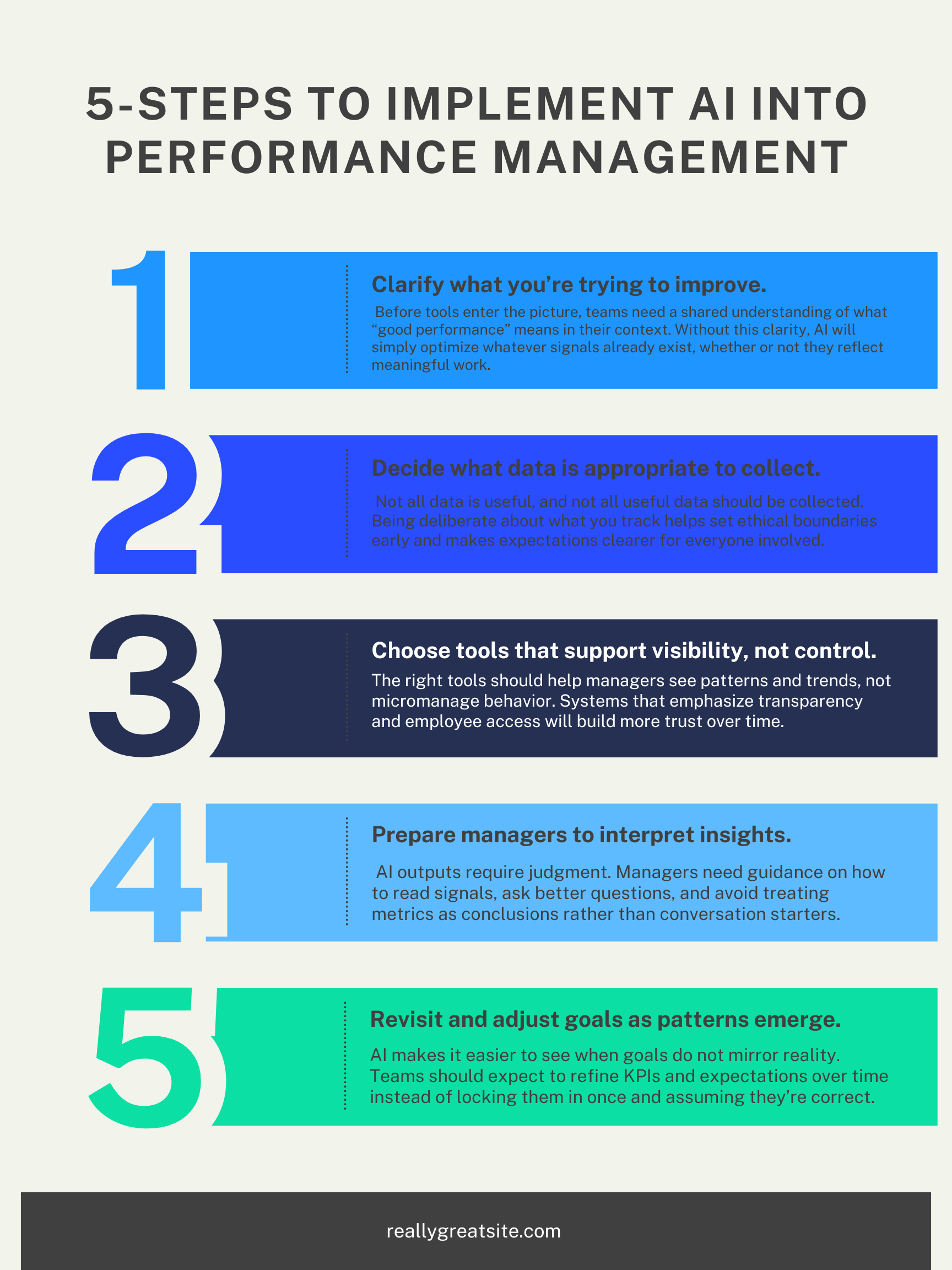
In short, automation handles the repetitive work of tracking and surfacing signals, while humans remain responsible for interpretation, context, and care. That balance is what keeps performance management useful and humane as systems become more and more sophisticated.
The future of AI and workforce performance
When people talk about the future of AI at work, it’s often framed as something distant or abstract.
In reality, many organizations are already experimenting with ways AI can support feedback, engagement, and performance conversations without turning them into something mechanical.
Here are a few ways that the future is already taking shape:
- Meta employees use Metamate, an internal ChatGPT-style tool, to search across their documents and generate summaries of yearly accomplishments and feedback. Many employees use it as a starting point for self-reviews and peer feedback.
- Boston Consulting Group has embedded AI directly into the competencies that drive evaluations and promotions, with nearly 90% of employees using AI and about half using it daily. Performance is assessed not on AI usage itself, but on how effectively employees apply judgment to AI-generated insights, with internal tools cutting review writing time by 40% while improving quality.
- Zapier implemented an AI-powered system that coaches employees through goal-setting, analyzes goal quality at scale, and feeds insights back to managers and leadership. The result was 91% participation, clearer and more measurable goals, and faster iteration.
Taken together, these examples show a future where AI doesn’t replace human judgment but nudges performance conversations toward greater clarity and responsiveness. It’s less about prediction as prophecy and more about helping teams notice what’s already happening, sooner than they otherwise might.
Why using AI for managing employee performance matters
At its best, performance management is meant to help people do better work and develop as individuals, not just prove that work happened.
AI matters here because it changes the conditions under which those conversations take place by:
- Shortening feedback loops.
- Reducing the reliance on memory and visibility.
- Replacing guesswork with patterns that can actually be examined.
- Ground the concept of “performance” in tangible metrics.
The real opportunity isn’t automation for its own sake. It’s using AI to support clearer expectations, more timely conversations, and fairer evaluations while keeping human judgment where it belongs.
If you’re curious about what this can look like in practice, tools like Hubstaff offer a practical starting point. By combining time tracking, productivity insights, and workforce analytics, Hubstaff helps teams see how work actually happens without losing sight of the people doing it.
Exploring a trial is a low-pressure way to determine whether AI-supported performance management aligns with the way your team operates today. Try it free for 14 days.
Frequently asked questions
How is AI used in performance management systems?
AI is used to analyze patterns in work data, surface insights, and reduce the manual effort required to track performance over time. It helps make feedback more timely and decisions more informed without replacing human judgment.
What is continuous performance management?
Continuous performance management emphasizes ongoing feedback and regular check-ins, rather than infrequent, formal reviews. The goal is to address performance closer to when work happens while there’s still time to adjust and improve.
How is AI changing performance management for HR professionals?
AI helps HR teams transition from reactive to proactive processes by identifying trends, risks, and opportunities earlier. It also reduces administrative burden, allowing HR to spend more time directly supporting managers and employees.
How do you measure performance management?
Performance management is measured by how clearly expectations are set, how consistently feedback is given, and whether performance conversations lead to improvement. Metrics can support this, but the real signal is whether people understand how they’re doing and what growth looks like.
Most popular
How to Spot and Manage Work Overload Before Your Best People Burn Out
Work overload occurs when the demands placed on an employee or team exceed their available resources, leading to stress, burnout,...
Workplace Productivity Statistics in 2026: What the Numbers Say
For many businesses, having the ability to maximize output without compromising quality gives them a major edge over their competi...
Time Doctor vs. ActivTrak: Which Tool Is Right for Your Team?
Time Doctor and ActivTrak are two of the most powerful and popular time tracking solutions. Both have strong features, and both ca...
Work-Life Balance Statistics in 2026: A Global Perspective
Work-life balance has become a deciding factor in how people, especially Gen Z, choose or leave jobs. The data shows that work-lif...



![How to Identify, Define and Prioritize Business Goals in A Startup [Examples]](https://hubstaff.com/blog/wp-content/uploads/2019/04/Goals-and-Task@2x-780x390.jpg)