How Many Meetings Are Too Many? 2026 Benchmarks by Role

 6 min read
- Employees average ~25 meetings/month with 70% recurring, and meeting volume has grown 6x in two years — making calendar overload a workday design problem, not a personal discipline issue.
- Individual contributors spend ~4 hrs/week in meetings while managers average ~9 hrs, yet only 39% of tracked work time is deep focus — signaling that poor meeting distribution, not just volume, kills productivity.
- Hubstaff's 2026 Global Trends & Benchmarks Report gives teams role-specific data on meeting load and focus time, helping leaders redesign calendars before overload pushes execution into evenings.
How many meetings are too many?
In 2026, the honest and boring answer is: it depends on your role.
Our 2026 Global Trends and Benchmarks Report makes that clear. Individual contributors average around four hours of meetings per week. Managers clock closer to nine hours, which accounts for nearly a quarter of their work time.
Across organizations, the typical employee attends about 25 meetings per month, and roughly 70% of those are recurring. The frequency of meetings across industries and roles proves that meetings are a workday design problem, not simply a personal responsibility.
The big issue isn’t that these meetings feel annoying (they are), but how their volume and distribution are hurting work. With meetings spread across mornings, afternoons, and time zones, team focus time becomes fragmented and valuable work gets pushed aside.
This article breaks down Hubstaff’s report findings by role, identifies where meeting load becomes a risk, and outlines what healthy meeting design looks like in practice.
Stay in the loop
Subscribe to our blog for the latest remote work insights and productivity tips.
Meetings aren’t the problem
For most teams, there wasn’t a single moment where meetings suddenly took over. They accumulated, beginning with a new sync here or a recurring check-in there. Seemingly harmless things, but over time, what began as coordination slowly hardened into structure.
The data unveils that pattern:
- Employees now average about 25 meetings per person, per month.
- Roughly 70% of those meetings are recurring.
- The average person is sitting in more than twice as many meetings as they were two years ago.
- The typical organization is running almost six times as many meetings, compared to just two years ago.
Recurring meetings can feel efficient. And to be fair, some of them are.
That said, an inefficient recurring meeting isn’t a one-off mistake. It’s a subscription that, once on the calendar, occupies space indefinitely.
The real issue is that the volume of meetings continues to grow with distribution going unchecked.
How many meetings per week is too many?
Different roles use time differently.
A designer or engineer needs long stretches of uninterrupted focus to produce meaningful output. A manager’s job, by contrast, is coordination. Their calendar will naturally carry more weight.
The mistake is assuming those two rhythms should look the same.
Here is what our benchmarks show:
| Role | Avg Meeting Time | % of Workweek |
| Individual contributors | ~4 hrs/week | ~10% |
| Managers | ~9 hrs/week | ~25% |
Individual contributors spend around four hours per week in meetings, amounting to 10% of their work week. For Managers, it’s higher at nine hours a week or ~25% of their time.
No matter the role, the risk begins when meeting load disrupts the natural rhythm of work — especially when the time required to coordinate overtakes the time required to do the job well. That’s when sustained attention is squeezed and work begins spilling into off-hours.
Every team has different needs, but comparing to benchmark data can help your organization understand how they stack up.
When meetings start destroying productivity
A calendar can look reasonable at a glance. A calendar can also undermine real work.
Both can be true at the same time.
Four meetings in a day doesn’t sound excessive. Even three hours total can feel manageable. The damage shows up in how those meetings are distributed, not how many there are.
Here’s what our data says about the distribution of meeting times:
- ~26% of all meeting minutes happen during 9 to 11 AM, the window most people consider prime maker time.
- ~30% of meeting minutes fall outside 9 AM to 6 PM, pushing collaboration into early mornings or evenings.
- The average workday includes ~185 minutes spent in meetings.
Each meeting may be justified. But together, they slice the day into segments too small for sustained thought and deep focus.
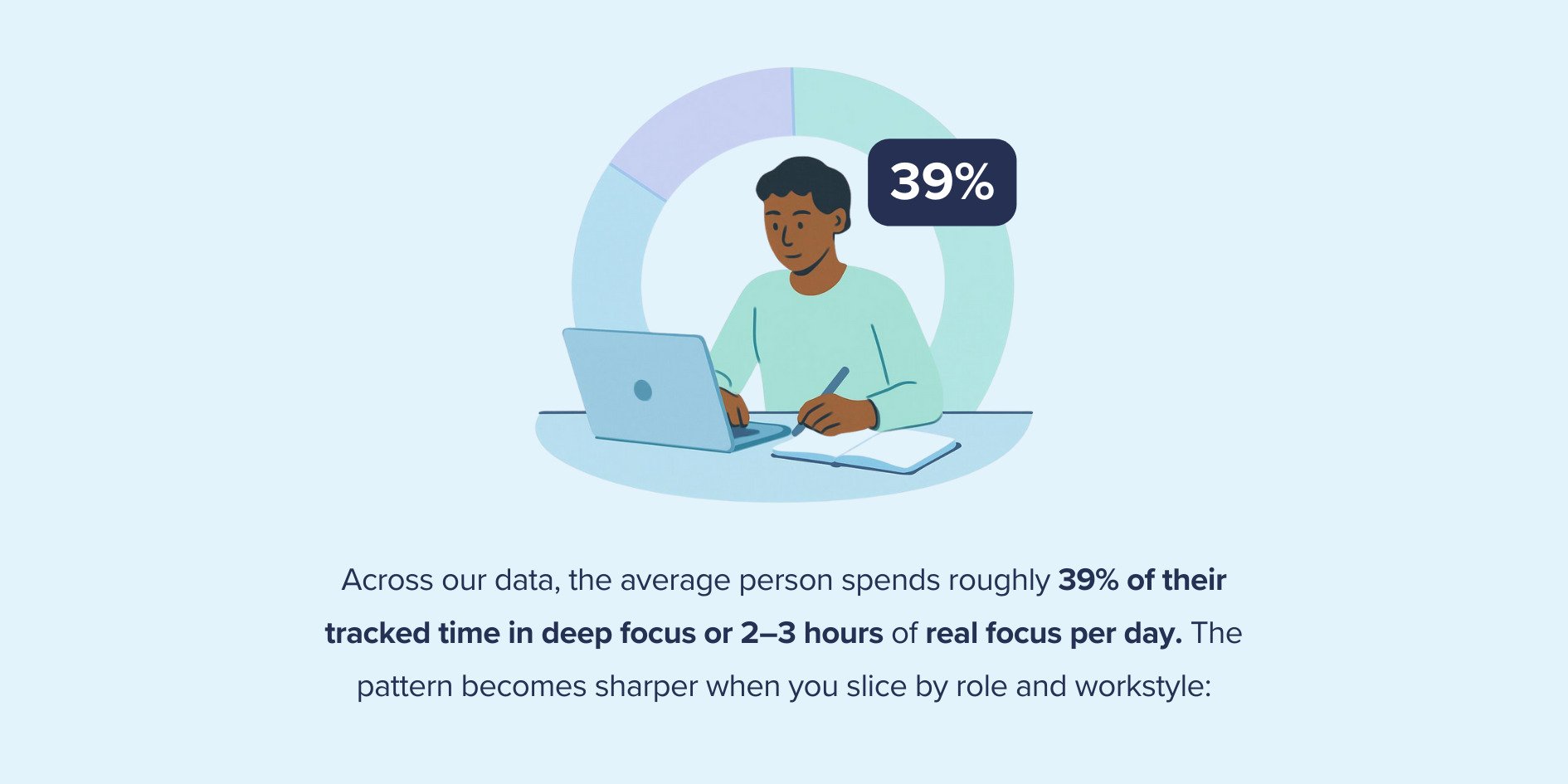
Across all roles, the average person spends just 39% of their tracked time in deep focus. That number is already tight. Scatter meetings across the day, and those focus windows shrink further, making it impossible to build momentum.
You don’t need to completely eliminate meetings to create a healthy calendar. You do need to contain them, though, so you can create protected blocks where deep work can happen without being constantly reset.
5 signs your team has too many meetings
If you’re trying to diagnose whether meeting load has tipped from healthy coordination into structural drag, look for patterns like these:
- Non-managers spend 20 to 25% or more of their week in meetings. For roles built around creation or analysis, that’s a meaningful amount of focus time gone.
- Recurring meetings dominate the calendar. When most of the week is pre-allocated by standing calls, there’s little room left for deliberate work.
- Regular collisions with the 9 to 11 AM focus window. Productive morning windows disappearing under status updates is an early warning sign.
- Meetings creep beyond normal working hours. Early calls and late syncs become the routine.
- A rise in 50+ hour weeks among managers or client-facing roles. Coordination during the day often pushes execution into evenings, which can then lead to burnout.
None of this is caused by lack of personal discipline. It’s a flawed design.
Calendars reflect how a team operates. If overload is showing up consistently, the solution isn’t asking people to “manage time better.” Instead, it’s redesigning how the work gets done. .
What “healthy” meeting design looks like in 2026
If you want fewer fragmented days and more meaningful progress, you have to design for it. Calendars don’t correct themselves, as they only mirror whatever norms are in place.
Here are concrete ways to reshape meeting load without breaking collaboration:
- Protect 2 to 3-hour morning focus windows. Especially for engineers, analysts, writers, and other high-focus roles, make the first hours of the day meeting-free by default.
- Define a 2 to 4-hour daily overlap window for global teams. Be explicit about when live collaboration happens. Outside that window, default to asynchronous updates and documented decisions.
- Rotate time-zone burden across regions. Early and late calls should be shared. If one office consistently absorbs the inconvenience, resentment builds quietly over time.
- Audit recurring meetings every quarter. Ask a simple question: if this meeting didn’t already exist, would we create it today? If the answer is no, retire it.
- Treat 50+ hour weeks as review triggers. When managers or client-facing roles repeatedly cross that threshold, examine whether meeting load during core hours is forcing execution into evenings.
Ultimately, the goal is to align meeting design with the rhythm of each role.
Creation-heavy roles need protected blocks, while coordination-heavy roles need structured collaboration. Healthy systems respect that difference instead of flattening everyone into the same calendar template.
Meeting load vs. capacity: The hidden connection
There’s a moment most managers recognize, even if they don’t name it.
The calendar fills the core hours, meetings stack from late morning through late afternoon.
Coordination gets done and decisions get made.
Productive on paper? Perhaps.
Then the “real work” starts at 8:30 PM.
According to our data, this pattern isn’t evenly distributed. Managers, customer support, and sales roles are the most likely to clock 50+ hour weeks. Not occasionally, structurally. These are the same roles carrying the heaviest meeting loads. That overlap isn’t a coincidence.
Extended meeting time during the day gets in the way of execution. Work expands into evenings because it has nowhere else to go, and that’s where the triple-peak workday shows up: a morning push, an afternoon stretch bent around meetings, and a third burst at night to get stuff done without interruption.
That third peak can be a form of flexibility, but only when used deliberately, and if it isn’t on top of an already-full work day. But if it is the default, it becomes harmful.
At some point, the narrative stops being about personal resilience. Sustained overload is a capacity planning signal. If certain roles consistently need nights to finish the work their meetings created, the system is out of balance.
But here’s the good news: systems, unlike individuals, can be redesigned.
Benchmark your team against 2026 data
Picture a week where mornings are focused.
Where engineers aren’t defending their calendars just to get two consecutive hours of thought. Managers still coordinate, but they aren’t making decisions at 10 PM.
That work day is achievable, but you can’t fix what you don’t measure. .
Our 2026 Global Trends & Benchmarks Report gives you a clearer lens on how teams like yours operate — broken down by role, industry, and workstyle. You can compare meeting load, focus percentage, and several other metrics to calibrate your team with.
If you want a more grounded way to set expectations and design fair guardrails, download the 2026 Global Trends & Benchmarks Report.
And if you’re ready to see these patterns inside your own team, Hubstaff can make time spent on meetings, focus hours, and role-specific benchmarks visible in real time.
Most popular
7 Tools That Help Monitor AI Usage at Work in 2026
AI is everywhere. Adoption continues to grow, but from monitoring AI usage, we’ve learned that daily use is still a mixed bag, a...
Hidden AI Usage in the Workplace: What Your Tools Don’t Tell You
How much has AI changed your team’s work? On the surface, work might not look that different. The meetings are still there, docu...
How Many Meetings Are Too Many? 2026 Benchmarks by Role
How many meetings are too many? In 2026, the honest and boring answer is: it depends on your role. Our 2026 Global Trends and Benc...
When Evening Work Becomes a Red Flag: How to Fix Triple-Peak Overload with Smarter Core Hours (2026 Data)
Most people don’t remember the first time they worked in the evening, and even fewer people know when the last evening work sess...