Spain’s 2026 Time Tracking Law: How to Replace Paper Timesheets with Compliant Digital Timekeeping

 9 min read
- Spain's 2026 time tracking regulation requires digital, tamper-resistant, audit-ready records retained for 4+ years — paper timesheets and spreadsheets are no longer compliant options.
- Compliant systems must auto-generate auditable records, support employee visibility into their own data, and meet GDPR standards — manual entry workflows create serious legal exposure.
- Hubstaff helps businesses transition quickly with real-time digital time capture, exportable reports, and transparent records that keep teams inspection-ready without disrupting daily operations.

Time tracking in Spain lived in a strange, in-between state for a long time: technically mandatory, but de facto negotiable. Paper timesheets, spreadsheets, and after-the-fact edits — all of this was common and rarely questioned.
Spain’s time tracking law in 2026 is ending that era.
Spain’s upcoming changes to working-time regulation mark a major shift. Time tracking is no longer treated as internal process hygiene or an HR formality. Instead, it’s being reframed as regulated infrastructure, as manual timekeeping not only slows teams down but also creates compliance risk. This is a major structural change for businesses still relying on paper-based systems.
In 2026, how working time is recorded will matter just as much as whether it’s recorded at all. Let’s take a look at Spain’s new digital timekeeping requirement and what tools you can use to stay efficient and compliant.
Hubstaff Walkthrough
Dive into our interactive demo and explore the features that make managing global teams easier than ever.

What is Spain’s 2026 digital timekeeping requirement?
At a high level, Spain isn’t introducing time tracking for the first time. Instead, it’s changing what counts as a valid record of working time. The shift is about getting away from informal logs and toward systems that produce verifiable, inspection-ready records by default.
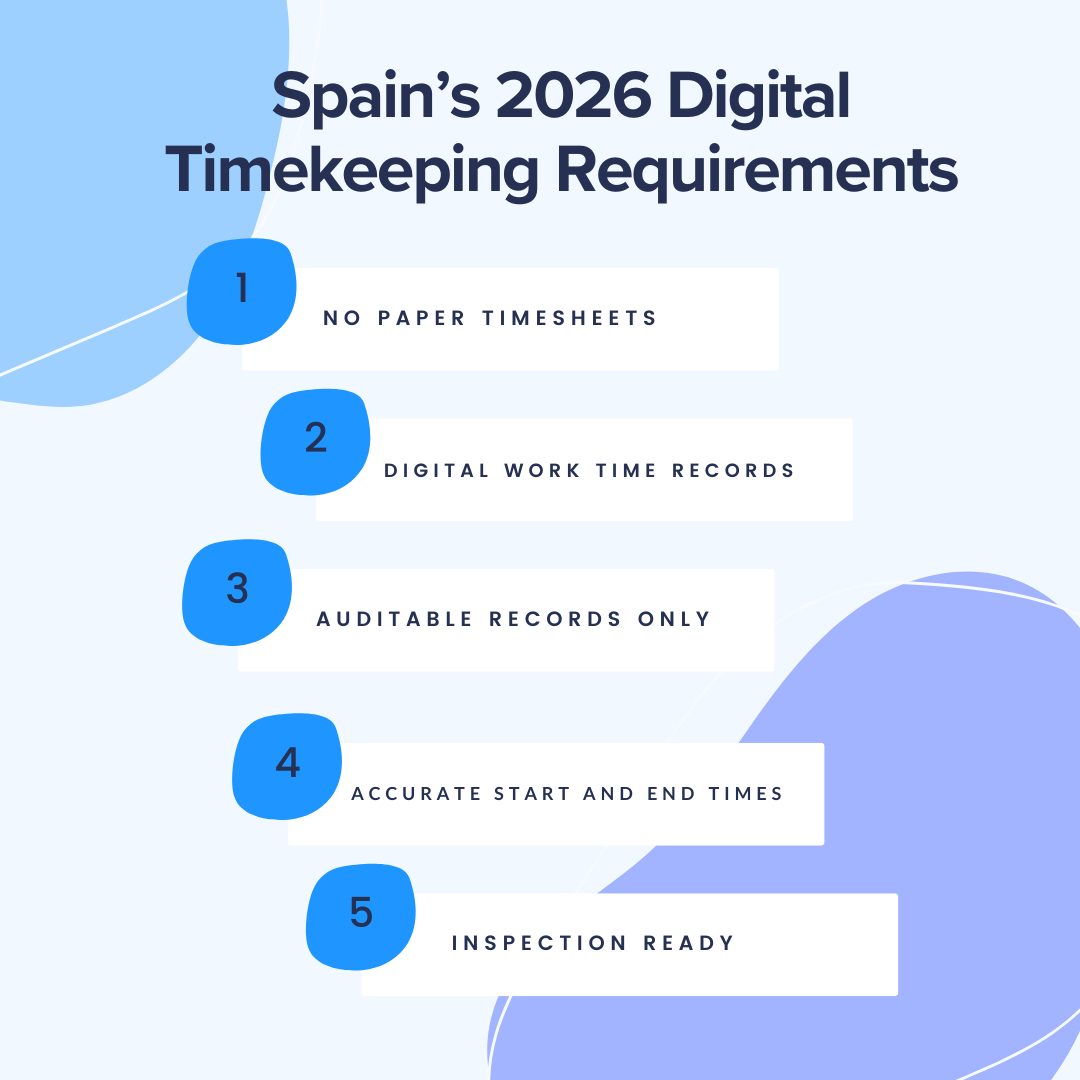
Under the proposed framework, compliant timekeeping looks materially different from what many businesses use today:
- Paper timesheets are being phased out. Manual records and handwritten logs are no longer considered sufficient, even if they’ve been accepted in the past.
- Working time must be recorded digitally. Records need to be created and stored in a digital system that’s objective, reliable, and accessible.
- Time records must be tamper-resistant or auditable. Employers can’t unilaterally edit hours without traceability or employee visibility.
- Daily working time must be captured accurately. Start and end times aren’t optional metadata — they’re the core of the record.
- Records must be inspection-ready. Labor authorities need to be able to access time data without reconstruction or delay.
The intent behind these changes is straightforward: Spain is trying to reduce time fraud, prevent unpaid overtime, and eliminate systems where working hours can’t be reliably verified after the fact.
Why paper and manual timesheets won’t work anymore
For a long time, paper timesheets survived because they were familiar, flexible, and rarely challenged. They worked well enough in environments where trust was implicit and scrutiny was occasional.
But under Spain’s new digital timekeeping requirements, that tolerance disappears — not because paper is suddenly inefficient, but because it can’t produce records that hold up under inspection.
At a basic level, manual time tracking breaks down in predictable ways. They are:
- Easy to alter. Paper records can be adjusted after the fact, often without any clear trace of what changed or why.
- Hard to audit. Verifying accuracy requires manual review, cross-checking, and reconstruction, which doesn’t scale.
- Inconsistent across teams. Different formats, habits, and interpretations create fragmented records that don’t tell a coherent story.
It’s tempting to assume spreadsheets solve this problem. They’re digital and in a familiar format for most, but they still fall short (and in more consequential ways) due to:
- No reliable timestamps. Entries are often added retroactively, with no system-generated proof of when work actually occurred.
- No activity context. Spreadsheets capture numbers instead of work sessions, making it difficult to validate how time was logged.
- No centralized audit trail. Changes can be made silently, without visibility for employees or inspectors.
As timekeeping moves from informal record-keeping to regulated infrastructure, businesses need tools that create accurate and traceable records by design, with reliance on manual discipline close to non-existent.
What “compliant time tracking software” actually means
At first glance, compliance-ready time tracking can sound incredibly complex. But in practice, it’s much simpler.
With the right software in place, teams don’t have to actively think about compliance daily. Instead, the best software provides audit-ready time logs and adheres to enterprise-grade compliance standards.
Digital, real-time capture
Compliant systems record working time as it happens, not hours later or days afterward. Time entries are created in real time and are tied to actual work sessions rather than reconstructed estimates. This removes ambiguity and reduces the need for manual correction or follow-up.
Immutable or auditable records
Once time is logged, it shouldn’t be silently alterable.
Whether records are fully immutable or simply auditable, the key requirement is traceability. In other words, any change must have a visible history. This protects both employers and employees by ensuring the record reflects what really happened.
Clear start-stop tracking
Compliance depends on precision. Clear start and stop points establish when work begins and ends, rather than relying on rounded totals or inferred schedules. Teams need this understanding for validating daily working time and accurately identifying overtime.
Exportable reports for inspection
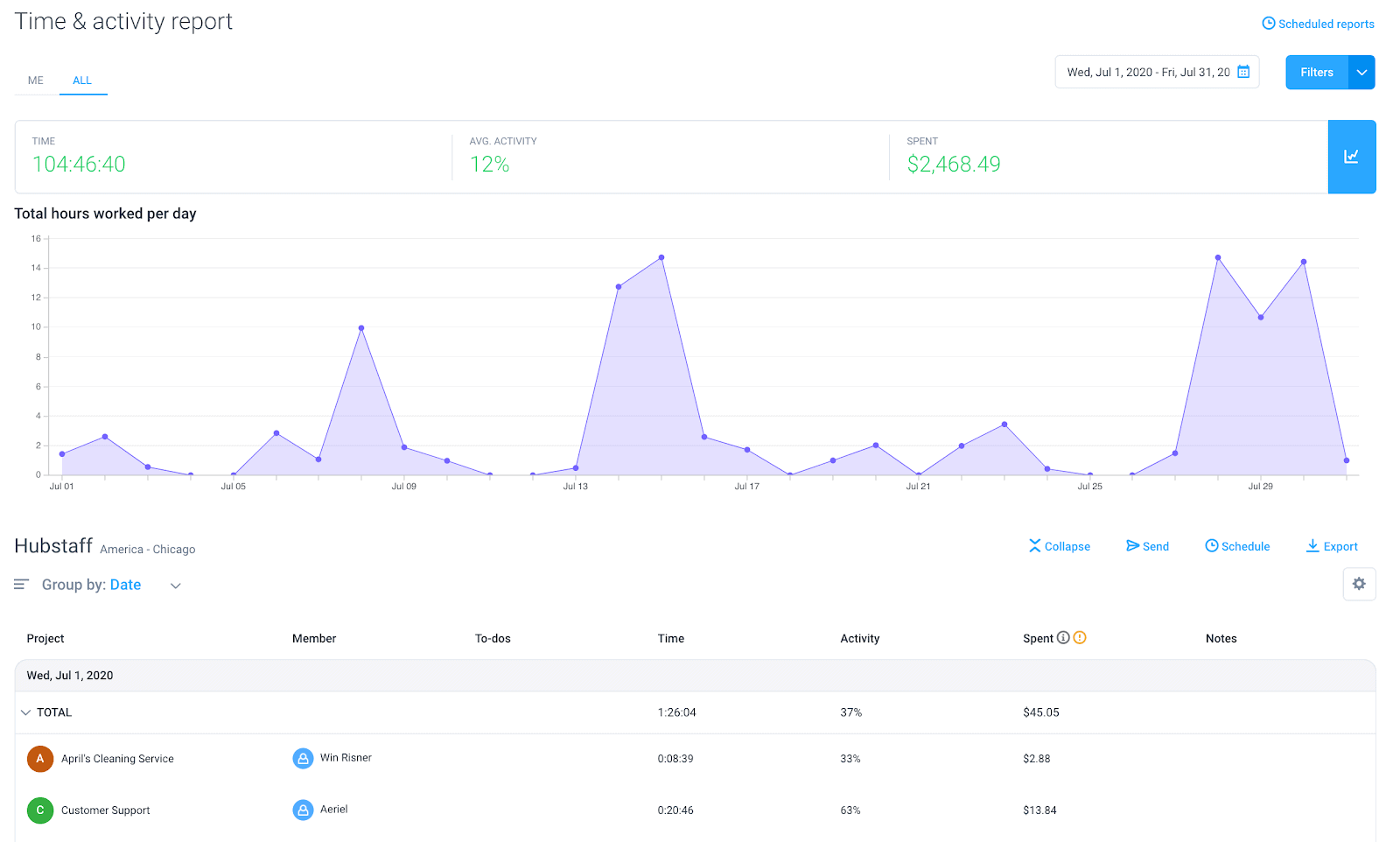
Time data isn’t useful if it’s trapped inside a system. Compliance-ready tools make it easy to generate structured, exportable reports that can be shared during inspections without additional processing. This way, inspectors can better understand the records without explanation or reconstruction.
Employee transparency and permissions
Employees need visibility into their own time records and clarity around what can and can’t be edited. Transparent access builds trust and aligns with regulatory expectations around consent and record integrity.
When everyone can see the same data, disputes are easier to resolve. A tool that supports these capabilities removes most of the friction from compliance altogether. If your system can handle time capture, integrity, access, and reporting in this way, you’re already most of the way there.
How Spanish businesses can move off paper — fast
Moving away from paper doesn’t have to mean months of disruption or a painful systems overhaul.
The fastest transitions tend to follow a simple pattern: understand what you’re doing today, identify what no longer holds up, and replace it with something you can use effortlessly.
Step 1: Audit your current time tracking method
Start with a clear-eyed look at how working time is actually recorded today. Not how it’s supposed to work, but how it works in practice:
- Who fills in the hours?
- When do they do it?
- How often are records corrected or clarified after the fact?
This step is less about documentation and more about identifying habits that may have become invisible over time.
Step 2: Identify compliance gaps
Once you know how time is tracked, the gaps tend to reveal themselves quickly. In paper or spreadsheet-based systems, common issues include:
- Time entries added retroactively (without proof of when work occurred)
- Records that can be edited without visibility or approval
- Different formats or rules across teams
- No clear link between a person, a work session, and a time entry
- Records that require manual cleanup before they can be reviewed
You don’t need a legal checklist here. Simply ask whether your current system could explain itself during an inspection without interpretation.
Step 3: Roll out digital tracking with minimal disruption
This is where many transitions can go wrong. Often, the mistake is making the change feel heavy for employees when it doesn’t need to be.
Ideally, leadership aligns on the system first, sets clear expectations, and removes ambiguity. For team members, the experience should be simple: install the app, start tracking time, stop when work ends.
Everything else (structure, reporting, access, etc.) should be handled at the system level, not pushed onto individuals.
Step 4: Train managers and employees properly
Training doesn’t involve showing what buttons to click. The bigger goal is getting a shared understanding.
Managers need to know how to read time data responsibly, using activity signals as context rather than judgment. Employees need to know why time is tracked, what’s visible, and how records are used. Transparency matters here. When people understand the purpose (compliance and accuracy, not micromanagement), trust is easier to maintain.
Step 5: Store and access records centrally
Records need a single, reliable home. Time data should be stored securely, retained consistently, and accessible without reconstruction. That means:
- Centralized storage
- Standardized reports
- Clear access controls
This way, when records are needed, they’re already complete, organized, and ready to share. A system that prioritizes storage and access turns time tracking from an ongoing chore into a major benefit.
How Hubstaff supports compliance-ready time tracking
Once the requirements are clear, the role of software becomes straightforward.
The right tool isn’t one that’s designed to redefine the regulation or add complexity. Its purpose is much simpler: to make accurate, verifiable time records the default outcome of everyday work.

That’s the lens Hubstaff fits into: practical support for the operational side of compliance.
Hubstaff, a compliant time tracking software, covers the core capabilities businesses need as they move away from manual systems:
- Accurate digital time tracking across devices. Hubstaff accurately captures time on desktop, web, and mobile. This matters for distributed, hybrid, and shift-based teams where work doesn’t happen in one place.
- Clear time logs tied to real work sessions. Instead of sifting through abstract totals, hours are connected to specific users, sessions, tasks, and projects. This makes records easier to understand and verify.
- Optional productivity signals for context. High-compliance environments can benefit from built-in productivity monitoring features, like optional screenshots, app usage, and URL data, which are available when needed. These signals, when used properly, infuse time records with context rather than serving as a substitute for trust.
- Exportable, inspection-ready reports. Time data can be generated and shared without manual cleanup, helping to keep businesses audit-ready at all times.
- Transparency controls that support employee trust. Hubstaff’s guiding principles center around trust and transparency. Visibility settings and permissions help ensure employees understand what’s being tracked and how their data is used.
Taken together, these features remove the need to explain or defend time records. For businesses navigating Spain’s shift toward digital-only timekeeping, this enables sustainable compliance.
Who needs to act first?
Not every business will feel this shift at the same speed, but some should treat it as immediate. The biggest signal isn’t company size or industry prestige but the tools still in use.
Businesses that are most exposed include those still relying on:
- Paper timesheets, punch cards, or handwritten logs
- Excel or Google Sheets — especially when hours are entered retroactively or managed across multiple versions
These systems may have worked under looser expectations, but they leave little room for verifiable records.
Particular industries are also likely to feel pressure earlier than others:
- Retail and hospitality. Shift work and variable hours make accuracy critical.
- Construction and field services. Work happens across locations and devices.
- Professional services with hourly billing. Time records directly affect pay and clients.
- Remote and hybrid teams operating in Spain. Oversight already depends on digital systems.
What’s important for these businesses is that they move early and deliberately.
What happens if you don’t prepare before 2026?
For most businesses, the real cost of waiting won’t show up as a single dramatic moment. It’ll appear as small problems stacking on top of each other once change is no longer optional.
That usually looks like:
- Operational disruption as teams scramble to replace familiar processes under time pressure
- Exposure during inspections when time records exist, but they can’t really explain themselves
- Rushed tool decisions that make no sense from an employee use standpoint
- Employee confusion when new systems appear without enough context or trust
None of this is catastrophic, but it’s noisy. More importantly, it’s all avoidable.
Compliance is the floor, visibility is the bonus
If there’s one thing to take away from all of this, it’s that time tracking in Spain is now being treated differently. It’s about building something that has to make sense even when the people who created it aren’t in the room.
Once you see it that way, a lot of the old workarounds stop making sense. Paper, spreadsheets, and backfilled hours — they all depend on someone explaining them later. The new direction assumes the record should explain itself.
That’s where things get better for teams that modernize early. When the system is doing the heavy lifting, people stop spending energy compensating for it. Conversations get simpler, and decisions get less fuzzy.
Compliance is just the baseline you have to clear. What employees really feel (and what leaders appreciate) is the visibility you get after that.
Frequently asked questions
Do spreadsheets count as digital time tracking in Spain?
Generally, no. While spreadsheets are digital files, they don’t meet the intent of the new requirements because they lack reliable timestamps, auditability, and built-in safeguards against after-the-fact edits. Under the proposed framework, “digital” means system-generated records — not manually maintained files.
Is time tracking mandatory for all employees?
Yes. In practice, it applies broadly. Spanish working-time rules already cover most employment relationships, and the proposed changes explicitly extend digital timekeeping requirements across contract types, including roles that were previously treated differently, such as senior management.
How long must time records be stored?
According to Spain’s Workers’ Statute, time records must be retained for a minimum of four years. They need to remain accessible and readable throughout that period, both for internal reference and for potential labor inspections. Be sure to read up on EU law, GDPR compliance, and other European and Spanish legal standards when assessing record-keeping best practices
Does time tracking software need employee consent?
Employees must have visibility into their own time records, and changes to those records generally require their acknowledgement or consent. Transparency around what is tracked, how it’s used, and who can access it isn’t optional.
Most popular
The Top Time Management Statistics in 2026 for Workplace Productivity
We all have the same hours in the day. But when employees struggle to focus, those hours likely won’t be used effectively. Witho...
The Best Coaching Conversations Start With Productivity Data
Most coaching conversations happen too late. A deadline is missed, or a client flags a problem, and then a manager schedules a sit...
A Quick Guide to Work Order Management
From quick fixes to long-term stability, work orders are crucial to asset management and helping managers keep operations running...
How to Identify High Performers Using Work Patterns
Every business has top performers, and managers are told to find them all the time. But in most cases, they default to approaches...
![How to Use Time Blocking to Make 2024 Your Most Productive Year Ever [Free Template]](https://hubstaff.com/blog/wp-content/uploads/2018/12/time-blocking@2x-780x390.png)