Employee Monitoring Statistics in 2026: Trends & Adoption

 5 min read
- Over 73% of employers now monitor remote or hybrid workers, and with the market projected to hit $8.29B by 2030, having a transparent, trust-first monitoring strategy is essential.
- Employees are more likely to accept monitoring when they understand the purpose; 85% say disclosure should be legally required, making clear communication a critical part of any workforce visibility strategy.
- Hubstaff's approach of giving employees access to their own data and the ability to delete it shows that effective monitoring is built on accountability and trust, not surveillance.

Keeping tabs on employees used to mean walking the floor and checking in face-to-face. However, with remote and hybrid work now the norm, we now look to employee monitoring statistics, trends, and software to evaluate employee performance.
Today, companies use time tracking, screenshot capture, and even AI-powered tools to understand how work gets done.
Some do it to boost employee productivity. Others do it to protect sensitive data or meet compliance requirements.
Either way, remote employees want to know where the lines are. Leaders need to be clear on what they’re tracking and why.
In this post, we go over the most important employee monitoring statistics, including what’s being tracked, how it’s changing, and what it means for businesses.
Stay in the loop
Subscribe to our blog for the latest remote work insights and productivity tips.
Key employee monitoring statistics
More and more companies are tracking how work gets done — and not just in the office. Here’s a look at some recent employee monitoring statistics for remote and hybrid teams:
- Over 73% of employers are monitoring remote or hybrid workers. A survey by ExpressVPN shows that many businesses treat tracking employee activity as the norm.
- 75% of employers monitor employees in physical offices. ExpressVPN also reports that 69% of employers use video surveillance monitoring, and 58.3% implement biometric access controls.
- 62% of employers save web browsing logs. 59% use real-time screen tracking, and 61% check AI-powered analytics to measure productivity.
- 48% of employers increased their use of employee monitoring software in the past year. Owl Labs’ State of Hybrid Work report also found that only 19% of workers say their company isn’t using tracking software.
- The employee monitoring software market is projected to grow to $8.29 billion by 2030. The Business Research Company foresees a CAGR of 15.9%, which is attributed to increasing remote work trends and rising cybersecurity concerns.
Monitoring is part of how modern teams operate, whether in the office or remotely. But what matters is how it’s used, and whether it supports both the work and the people doing it. Let’s take a look at some employee monitoring trends to learn more about how businesses are using employee monitoring technology.
What trends are shaping employee monitoring in 2026
ExpressVPN’s survey on employee monitoring trends revealed that many companies now focus on real-time activity tracking. Most tools now offer live data on app usage, idle time, and task switching, which managers use to understand how work moves throughout the day.
According to a systematic review of 269 studies, published in the Journal of Business Research, improving performance and productivity are the two most common reasons companies implement employee monitoring. In other words, employers are using monitoring to understand and improve how work gets done, not to spy on employees.
Demand for operational visibility has increased in remote and in-office setups to ensure work gets done and teams aren’t trapped in bottlenecks. As a result, we’re seeing more companies lean into detailed monitoring, and some are even layering in AI to spot patterns or flag anything unusual.
As monitoring technology becomes increasingly popular, the responsibility to use it ethically becomes more important. Remote workers want to be trusted, so the more visibility you gain into your team’s day-to-day lives, the more careful you need to be. That doesn’t mean skipping monitoring altogether, but it does mean being thoughtful about how it’s introduced, how much is tracked, and how it’s talked about.
The challenge is figuring out how to maintain that sense of trust while giving leaders the insights they need to support their teams. Clear policies, honest conversations, and reasonable boundaries can make a big difference.
Employee privacy and awareness
While most workers aren’t necessarily opposed to employee monitoring, they do want to know how and why they’re being monitored. 85% of workers state that employers should be legally required to disclose when they’re using employee monitoring tools.
Organizations also benefit from explaining when and why they’re using monitoring software because it makes it more likely that employees will accept it.
It’s easy to understand why: when you introduce monitoring without explanation, employees tend to assume the worst. But if you take the time to clearly explain why monitoring is being implemented and how it benefits both employees and the organization, adoption is bound to happen more smoothly.
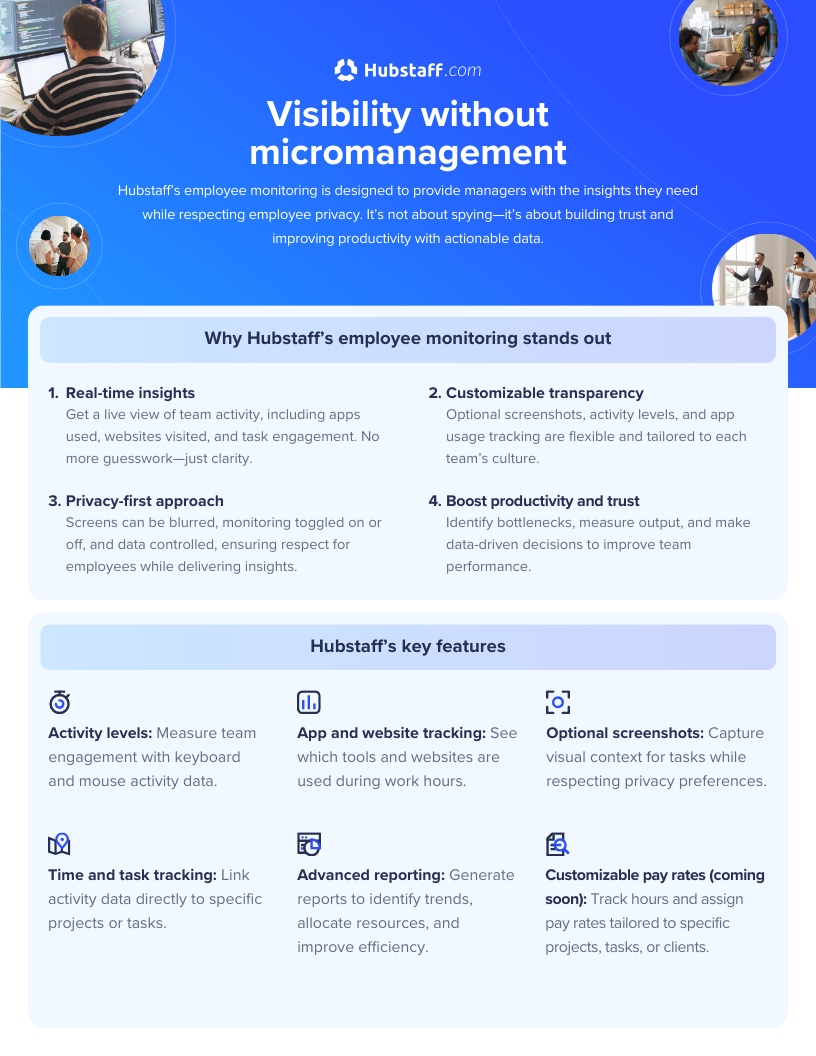
This is the reasoning behind Hubstaff’s guiding principles of transparency, access, and control. Employees can see the same data as their managers, and they’re free to delete it if needed. This helps to build trust both ways and enables organizations to use time tracking in a way that empowers teams.
Legal and ethical considerations of workplace monitoring tools
Monitoring tools can be helpful, but they can do more harm than good if you’re not careful with how you use them.
Employee monitoring laws are somewhat lax in many countries, which means that individual companies are responsible for determining what’s fair and what crosses the line—but here’s the problem: Most employees don’t feel like they’re hearing the full story.
From there, trust deteriorates, and it’s hard to get back once trust is gone.
If you’re setting up or updating a monitoring system, here are a few ways to approach it ethically:
- Start with a conversation. Be upfront about what you’re tracking and why it matters.
- Keep it focused. Only track what’s necessary for the job. Skip anything that feels overly invasive.
- Share the data. Let employees see what’s being collected. When you obtain employee consent (or at least alert them to what’s being monitored), it helps shift the tone from “surveillance” to “accountability”.
- Review regularly. Check in with your team. See what’s working and what isn’t, and adjust as needed.
Regardless of your ultimate goal, monitoring is an exercise in trust. It won’t work if people feel you’re monitoring them for the wrong reasons.
Hubstaff takes legal compliance seriously – however, we are not lawyers and cannot give legal advice. If you have concerns, you should consult with your legal counsel regarding your planned use of our services.
We do recommend disclosing when and how you are using Hubstaff to any employees or contractors before using our services. This helps ensure transparency and gives them a chance to fully understand what the software does.
What is the outlook for employee monitoring?
The future of employee monitoring is looking less rigid and more thoughtful.
AI and automation appear in subtle ways in a modern employee monitoring solution. For example, Hubstaff Insights can detect patterns in how people work and flag signs of burnout and poor mental health, helping managers understand where their time is really going while improving employee engagement and job satisfaction.
At the same time, there’s more pressure to handle that information carefully. People want to know what’s being tracked and why.
Over the next few years, expect the conversation to keep shifting toward trust and giving employees more say in how they’re monitored. More teams are moving away from employee surveillance and toward productivity monitoring, with a focus on understanding how work gets done instead of watching individuals.
The software will keep getting smarter, but the real progress will come from how teams choose to use it.
Most popular
The Top Time Management Statistics in 2026 for Workplace Productivity
We all have the same hours in the day. But when employees struggle to focus, those hours likely won’t be used effectively. Witho...
The Best Coaching Conversations Start With Productivity Data
Most coaching conversations happen too late. A deadline is missed, or a client flags a problem, and then a manager schedules a sit...
A Quick Guide to Work Order Management
From quick fixes to long-term stability, work orders are crucial to asset management and helping managers keep operations running...
How to Identify High Performers Using Work Patterns
Every business has top performers, and managers are told to find them all the time. But in most cases, they default to approaches...