What the 2026 Data Shows About How Work Is Really Structured Today

 4 min read
- Across 140,000+ workers, only ~39% of tracked time is spent in deep focus, with hybrid teams averaging just 31% — revealing a systemic design problem, not a people problem.
- Long workweeks cluster by role, not effort: 28% of managers logged 50+ hour weeks, yet research confirms output plateaus beyond 55 hours while fatigue keeps compounding.
- Hubstaff's 2026 Global Trends Report turns hours and focus data into early warning signals, helping leaders redesign workloads before burnout becomes the only visible outcome.

Work has changed faster than most teams have had time to redesign it. Global collaboration is now normal, tools have multiplied, meetings fill the calendar, and AI is everywhere.
That said, many organizations are still relying on inherited assumptions about productivity, that:
- More availability equals more output.
- Meetings are the safest default.
- Long weeks are just the cost of getting important work done.
The result isn’t that people aren’t working hard, but that work itself has become harder to do well.
This article highlights a few key patterns from Hubstaff’s 2026 Global Trends and Benchmarks Report. The full report provides deeper role-level benchmarks, analysis by workstyle, and practical playbooks for redesigning how work actually happens, based on anonymized data from more than 140,000 workers across 17,000 organizations using Hubstaff.
Stay in the loop
Subscribe to our blog for the latest remote work insights and productivity tips.
Focus time has become the rarest resource, but teams don’t notice until it’s gone
Most teams don’t realize they have a focus problem until results start slipping.
Work feels busy but strangely incomplete. People log on earlier or stay later, not because they want to work more, but because it’s the only time of the day that feels quiet enough to think.
The data in our report uncovers that pattern. Across over 140,000 workers, uninterrupted focus now accounts for an alarmingly small share of the workday. On average, people get about 2–3 hours of real focus per day, and that number drops further depending on role and workstyle.
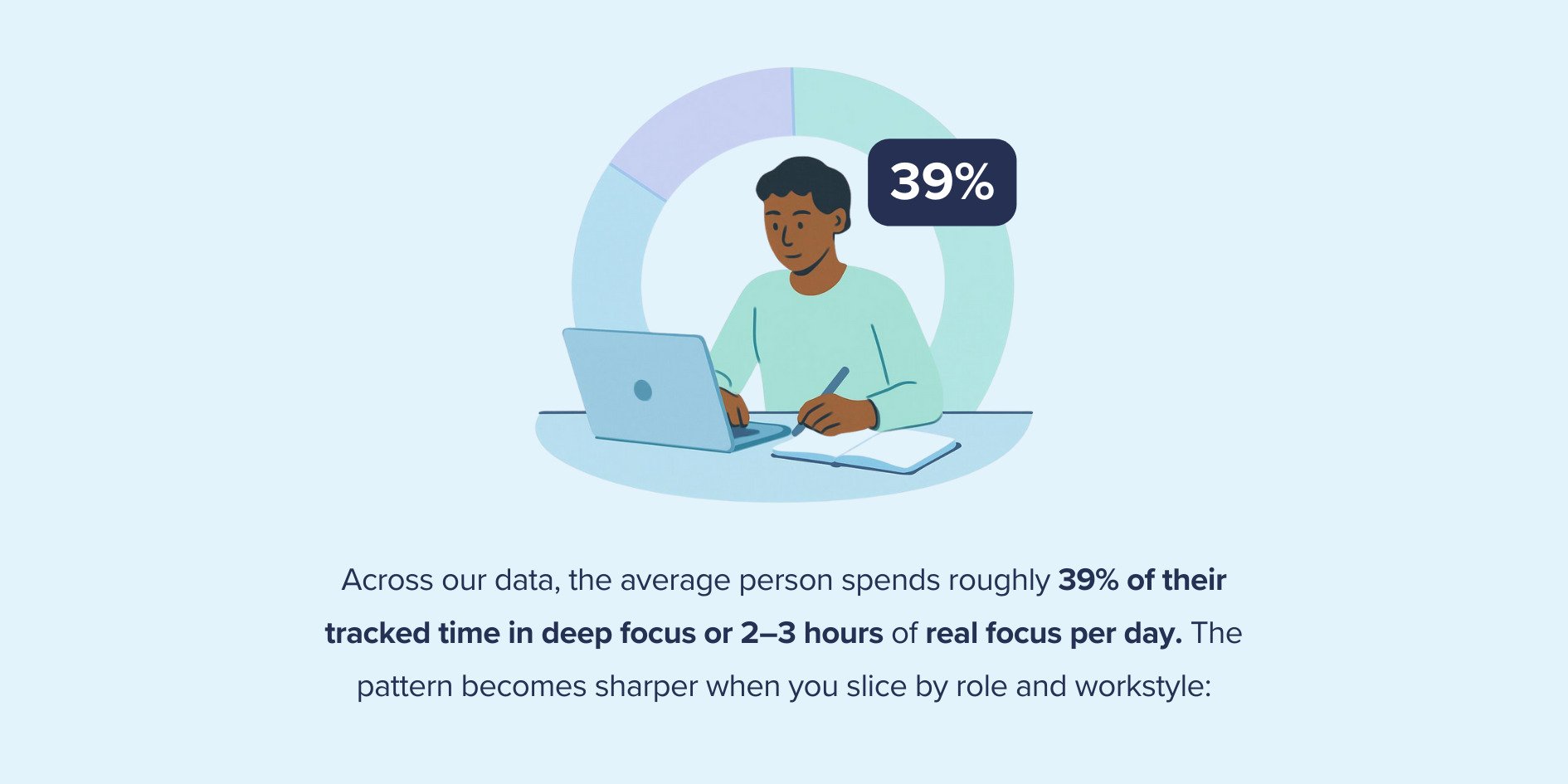
- Across all roles, only ~39% of tracked time is spent in deep focus.
- Hybrid teams average just 31% focus time, significantly lower than office-based (45%) and fully remote teams (41%).
- Highly collaborative roles like product managers, project managers, and founders often fall to 1–2 hours of focus per day, with focus percentages in the mid-20s.
- More than 20% of the time is spent on “work about work”: meetings, status updates, searching for information, and coordination.
What’s striking is how collaboration is distributed.
Meetings, for instance, aren’t confined to clear blocks. They’re spread evenly across the day, slicing potential focus windows into fragments too small to support deep work. A standup here, a quick sync there, or a review late in the afternoon. While each appears reasonable on its own, they are collectively corrosive.
The implication is uncomfortable but useful: focus isn’t inherently something people can “protect harder,” but an outcome of system design.
Focus breaking down is typically a signal that capacity, expectations, or collaboration norms need adjustment. Very rarely does it imply that people are underperforming.
Long workweeks don’t happen by accident
Long weeks don’t usually arrive all at once. They often start with a few late nights here and there — but suddenly that time adds up. One day, a 50-hour week stops feeling like an exception and starts feeling normal. By the time leaders notice, the pattern is already baked into how work gets done.
When we looked at weeks that crossed the 50-hour mark, long hours weren’t evenly distributed. Instead, they were clustered by role, showing that individual effort and motivation aren’t driving factors.
- 28% of team leads and managers logged at least one 50+ hour week.
- 21% of customer support roles crossed that threshold.
- 18% of sales and marketing roles did the same.
- By contrast, engineers showed fewer extended weeks, with under 5% of all observed weeks exceeding 50 hours.
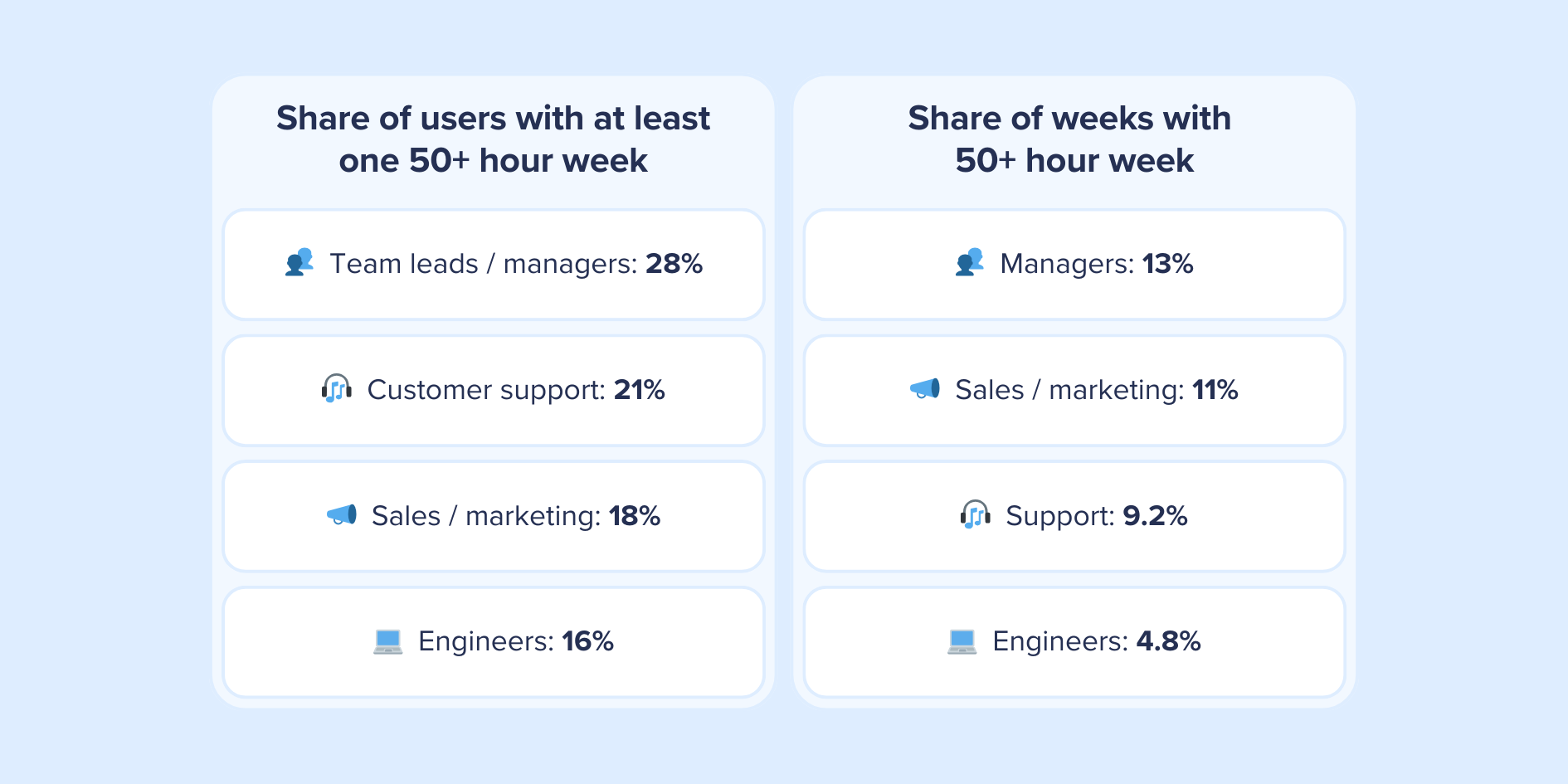
If long hours were simply about work ethic or ambition, the pattern would be random. Instead, the same functions keep absorbing the pressure. That’s usually where demand, coordination work, or unclear scope has outpaced capacity.
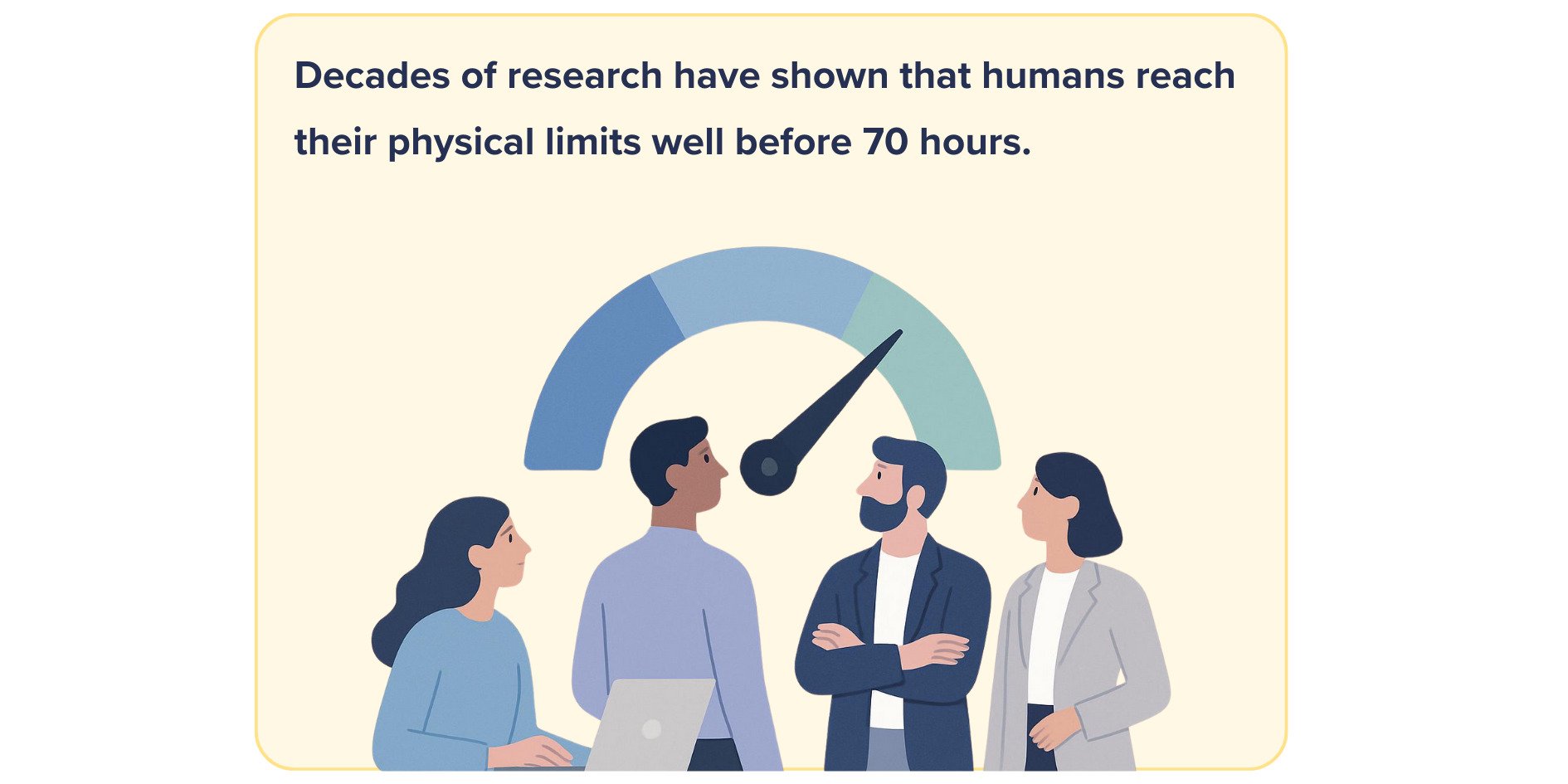
There’s a temptation to treat these weeks as necessary pushes. However, research has been consistent for decades: beyond roughly 50–55 hours, output plateaus.
Fatigue, on the other hand, does not. The extra time rarely produces proportional results.
Hours matter more when you can see them
Most leaders don’t lack concern about overwork, but they often lack visibility into where it’s coming from. By the time long weeks show up in a conversation, they’ve usually been there for a while. From the outside, everything still looks functional.
But that’s the problem: Hours on their own don’t explain much. What matters is patterns themselves. Some great questions to ask are:
- Which roles are consistently stretched?
- When do long weeks appear during the cycle?
- How often does focus break down before hours expand?
Without that context, long weeks get treated as anecdotes instead of signals. Leaders rely on gut feel or after-the-fact conversations about burnout to understand what’s happening. By then, the system has already adjusted to account for the strain.
Making hours visible means seeing the workload clearly enough to design it better. When time, focus, and capacity are observable at the team level, preventing long weeks becomes more attainable.
That’s the shift this report is designed to support: moving from reacting to overload after it shows up, to recognizing the early signals while there’s still room to change course.
Get the full report: The 2026 Global Trends and Benchmarks Report
Inside the report, you’ll find role-level benchmarks, patterns across global teams, and practical signals leaders can use to spot problems early and redesign how work flows day to day.
It’s built on anonymized data from more than 140,000 workers, with the goal of replacing guesswork with clearer visibility into how time, focus, and capacity interact.
Download the full report to see how your team compares and where small changes in design can make work more sustainable without asking people to stretch further.
Most popular
The ROI of AI in Workforce Tools: Measuring Business Impact in Distributed Teams
It’s hard to pinpoint the exact moment AI became the standard in tech, but it’s a bit strange to picture a time before it now....
7 Tools That Help Monitor AI Usage at Work in 2026
AI is everywhere. Adoption continues to grow, but from monitoring AI usage, we’ve learned that daily use is still a mixed bag, a...
Hidden AI Usage in the Workplace: What Your Tools Don’t Tell You
How much has AI changed your team’s work? On the surface, work might not look that different. The meetings are still there, docu...
How Many Meetings Are Too Many? 2026 Benchmarks by Role
How many meetings are too many? In 2026, the honest and boring answer is: it depends on your role. Our 2026 Global Trends and Benc...